The name described a hybrid idea
The spinning mule acquired an animal name because it brought together features associated with earlier spinning machines. Samuel Crompton developed it around 1779, combining drawing rollers with a moving carriage carrying spindles. The result was not simply a spinning wheel multiplied to serve more threads at once. It coordinated different motions in a sequence capable of producing fine, strong yarn. Its history is often compressed into the name of an inventor and a year, but the machine becomes more understandable when the movement, the product, and the conditions of its spread are considered together.
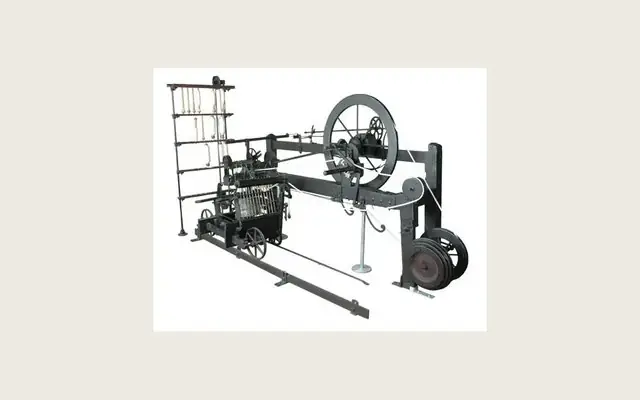
Prepared fibres entered a drawing arrangement in a fixed frame. A carriage carrying the spindles moved outward, helping draw and twist the strands. The return movement formed another part of the sequence, during which the newly spun yarn was wound. The machine therefore depended on coordinated stages rather than on one continuous motion doing everything identically throughout. Lancashire Museums' account connects the outward and return movements with the handling of the fibres. That distinction supplies a practical explanation of the invention: the arrangement controlled the relationship between drawing, twisting, and taking up yarn in a way that supported the desired quality.
The carriage made a sequence of operations
Fine yarn expanded possibilities for fabrics such as muslin. The product mattered because manufacturing is not a competition in which the machine with the most visible movement automatically wins. A successful spinner had to supply yarn suited to the requirements of weaving and the market. Crompton's device offered an important combination of fineness and strength. Its significance came from that useful result as well as from increased output. Looking at what a machine makes can therefore be as important as looking at how many components it contains or how large a factory eventually grew around its descendants.
Crompton worked at Hall i' th' Wood near Bolton, and his early device was also known through names associated with that location and with muslin. The later familiar name should not be imagined as a product label fixed from the beginning. Nor was the invention protected by a patent that allowed its maker to control every subsequent use. Manufacturers copied and developed it, and Crompton did not receive a share of the resulting wealth proportionate to the machine's influence. The distinction between an invention's importance and its inventor's financial outcome is central to this story.
A useful machine could spread beyond its maker
The mule continued to change after its first development. Later machinery used more spindles and more extensive power and control systems. Richard Roberts's self-acting mule of the 1820s belongs to that subsequent history, rather than being a feature already complete in Crompton's original arrangement. Remembering the sequence prevents an early inventor from being credited with every property of the mature technology. It also gives later builders their proper place. A productive principle can provide the starting point for a long chain of modifications, with the widely used factory machine differing substantially from the version that first demonstrated its possibilities.
The cotton economy connects that technical development to a much wider human history. Increased demand for raw cotton linked British mills with plantation production and enslaved labor, especially as the industry expanded in the nineteenth century. Bolton Museum's curators explicitly connect their surviving machine with that history in the Revealing Histories project. A mechanical improvement does not explain the whole system, but it belongs within it. The wealth generated through cotton production cannot be understood only by measuring yarn output or celebrating a local industrial hero. The origin of the material and the labor supplying it also matter.
A museum object connects invention with consequences
The surviving mule made by Crompton in Bolton Museum dates from around 1802, after the invention's initial development. A Science Museum example is a replica derived from later equipment rather than the original prototype of 1779. These distinctions are useful when reading photographs. An early machine made by the inventor, a replica, and a later self-acting mule can all illustrate the broader history, but they do not provide interchangeable evidence about the same moment. Captions and provenance keep the viewer from treating every old spinning machine as the first apparatus that emerged from Crompton's workshop.
The mule's importance is clearest when its technical and social histories remain connected. Its moving carriage and rollers controlled a sequence that produced valuable yarn; its circulation encouraged further development; its success helped expand an industry with deeply unequal consequences. Crompton's limited reward gives one example of that inequality, while the cotton supply reaches far beyond his individual circumstances. A museum machine preserves more than a clever mechanical arrangement. It provides a point from which to investigate how an invention became widespread, who benefited from it, and whose work made its growing productivity possible.