A ship was a combination of choices
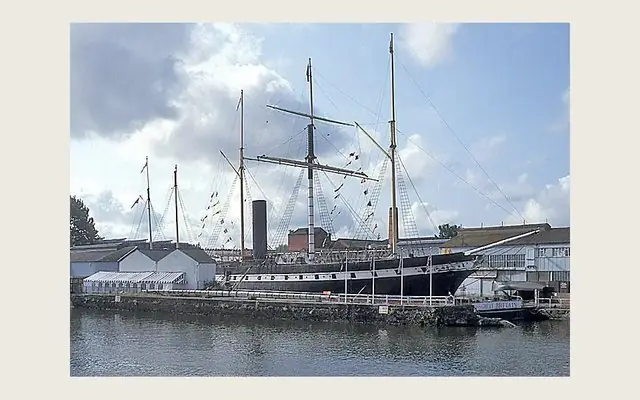
When SS Great Britain was launched at Bristol in 1843, its significance lay in a combination of engineering decisions. It had an iron hull and screw propulsion, bringing together approaches that would become central to ocean-going ships. Isambard Kingdom Brunel served as project engineer, while William Patterson and the dockyard workforce turned the undertaking into a vessel. The achievement should not be reduced to a claim that nobody had previously built an iron boat or experimented with a propeller. Its importance came from applying those ideas together at the scale and ambition of a major ocean steamship.
The hull was made from wrought-iron plates riveted to iron frames. This construction provided a different way to establish the size, strength, and internal arrangement of a ship from the methods familiar in timber building. The resulting vessel was exceptionally large for its time. Yet material alone did not supply a complete design. Frames, plates, connections, compartments, machinery, and accommodation had to work together. A ship's seaworthiness and commercial usefulness emerge from those relationships, making the hull an essential part of a larger system rather than a self-sufficient invention whose effects followed automatically.
The propeller changed the arrangement of propulsion
Brunel's original proposal used paddle wheels, but the design changed to a screw propeller. That change was more consequential than replacing one object at the stern with a different object at the side. It affected how engine power reached the water and how the machinery was organized within the vessel. The original engine transmitted its motion through a chain-drive arrangement. The ship demonstrated how screw propulsion could be incorporated into an ambitious ocean-going design. Its later influence belongs to that practical demonstration, not to an assumption that every problem associated with marine propulsion had been permanently solved at launch.
Sails also belonged to the vessel's equipment. Steam and sail were not mutually exclusive identities in this period, and retaining a sailing rig could serve useful purposes on long passages. The combination offers a corrective to illustrations of technological change as a series of complete replacements. An engineer or operator had to consider reliability, fuel, distance, and the conditions a ship might encounter. The vessel's rig and propulsion arrangements changed over its working life. Reading one configuration as though it represented every voyage would erase the adjustments through which the ship continued to serve different requirements.
Service transformed the original vessel
The launch ceremony and the beginning of ocean service were separate stages. Launched in 1843, the ship began its transatlantic working career in 1845, carrying passengers between Liverpool and New York. Subsequent employment included the Australian route. These journeys connect the engineering with people whose experiences could vary greatly according to accommodation, circumstances, and purpose of travel. The ship was not only a large machine crossing a map. It was a temporary living environment, and a historical account becomes fuller when the demands of passengers and crew are considered alongside the engine and hull.
Later use and alteration carried the vessel far from its original role. Eventually it remained in the Falkland Islands, where the surviving hull endured after its seagoing career had ended. Its rescue and return to Bristol in 1970 were therefore not the conclusion of an uninterrupted passenger service. They were a major preservation undertaking directed at a structure that had accumulated different uses and conditions. That distinction matters because a museum ship often presents a coherent historic appearance while its material survival records a much less tidy sequence of employment, repair, replacement, and deterioration.
A return to the dock of construction
At Bristol, the ship returned to the dock in which it had been built. Conservation and interpretation required decisions about which periods to represent and which features to reconstruct. National Historic Ships identifies surviving original hull fabric alongside replicated interiors, machinery, masts, and equipment. Those distinctions are part of the object's historical value. A reconstruction can explain an absent mechanism without becoming original nineteenth-century material. Equally, a weathered surviving plate can provide evidence even when it is less visually complete than a newly made representation. The two forms of preservation answer different questions for a visitor.
SS Great Britain's history thus extends beyond the moment when iron and a screw propeller came together in a celebrated design. It includes the work of construction, the transition into service, changing routes and equipment, a long period far from Bristol, and the engineering of preservation. The vessel's importance is strengthened by that longer view. A ship that influenced later practice also remained a particular physical object, subject to use and change. Its return made it possible to study both the original ambition and the complicated material history through which that ambition survived.