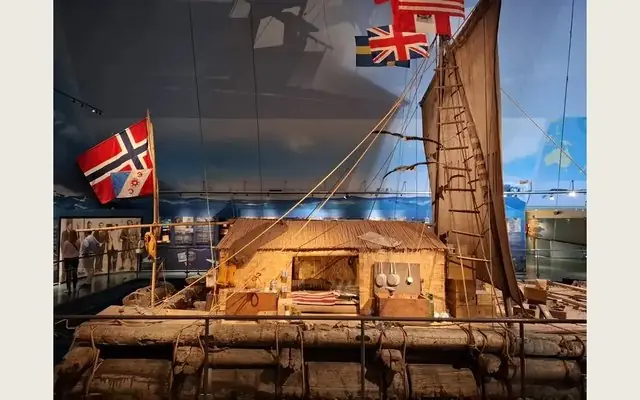
Six people set out on a balsa raft
On April 28, 1947, six men left Callao in Peru aboard a balsa-wood raft named Kon-Tiki. Thor Heyerdahl organized the voyage to investigate an idea about movement across the Pacific from South America toward Polynesia. After 101 days, the raft reached the reef at Raroia in the Tuamotu Islands. The passage was an extraordinary practical achievement, but its historical meaning is more interesting when stated carefully. Demonstrating that a particular kind of vessel can make a journey is not the same as demonstrating that a particular ancient population actually made that journey and settled the destination.
The raft made material capability visible. Balsa logs, lashings, a deck arrangement, and a sail had to support people through a long passage on open water. The journey challenged dismissive assumptions about what a raft could endure. At the same time, it was a twentieth-century undertaking, organized by people who brought their own knowledge, preparations, and purposes. No experimental voyage can remove the circumstances of its own creation. Its value lies in examining a possibility under specified conditions, not in becoming a literal replay of an undocumented event simply because the vessel resembles an earlier form.
A successful demonstration answers a limited question
Heyerdahl connected the expedition with a wider theory about South American contributions to the settlement of the Pacific islands. The distinction between an ocean crossing and that theory is essential. A successful arrival supplies evidence about navigation, flotation, and the conditions experienced by one crew. Claims about population history require additional evidence concerning people, dates, language, archaeology, and relationships among communities. The voyage could contribute to a discussion without independently deciding it. This is not a dismissal of experimental archaeology; it is an explanation of why an experiment becomes stronger when the question it answers is stated precisely.
The same reasoning applies to failure. If a replica vessel founders, its loss does not necessarily prove that earlier people could never have travelled in a related craft. Differences in construction, loading, knowledge, weather, and operation may matter. Conversely, success does not establish that every proposed historical account using that craft is correct. Kon-Tiki became a memorable case because the dramatic result and the broader claim were easy to merge in popular retellings. Keeping them apart allows the voyage to remain an impressive achievement while leaving the historical argument open to evidence of other kinds.
Other evidence asks who travelled and when
Later genetic research has supplied evidence for contact between Polynesian and Indigenous American populations before European arrival. A study reported by Stanford Medicine in 2020 identified shared ancestry signals and investigated their timing and geographical relationships. That research addresses a different question through different methods from a raft voyage. It does not turn the 1947 expedition into proof of every part of Heyerdahl's migration theory, nor does evidence of contact mean that Polynesian history can be reduced to one origin story. Contact, the direction of a particular journey, and the wider settlement of a region remain distinguishable issues.
The expedition's records provide another kind of historical evidence. Heyerdahl kept a diary for the voyage, while crew member Knut Haugland recorded personal observations. The museum's account of Haugland's diary emphasizes the difference between an official narrative and an individual's record of experience. Such sources can illuminate daily routines, reactions, and the organization of life aboard. They should not be treated as interchangeable accounts merely because they concern the same passage. Comparing records allows historians to investigate the expedition itself, rather than using every document only as support for the theory that motivated it.
The voyage survived through objects and records
Books, film, photographs, and the surviving raft helped turn Kon-Tiki into a widely recognized event. That public life forms part of the story. A voyage can influence imagination through the ways it is recorded and presented, even when scholars distinguish its achievement from the historical conclusions drawn around it. The raft displayed in a museum is therefore both an object associated with a real passage and a focus for later interpretation. Its material features invite questions about construction, while the archive invites questions about planning, experience, argument, and the creation of a celebrated expedition narrative.
Kon-Tiki remains compelling because it joins physical courage with a useful lesson about evidence. The crew completed a demanding crossing in a vessel many people doubted could succeed. That result expanded the discussion of what was possible, but possibility alone cannot name ancient voyagers or establish a complete migration history. The richest account preserves both parts: the accomplishment at sea and the limits of what it could demonstrate. In that form, the story invites curiosity without requiring a spectacular journey to carry more historical proof than the voyage itself can provide.