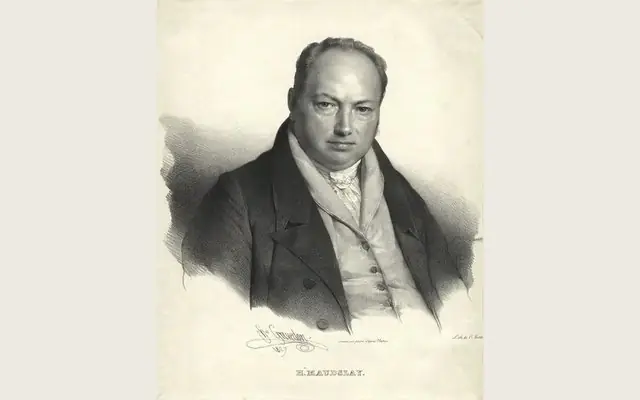
A screw required a relationship between motions
A screw thread is a pattern whose usefulness depends on consistency. The groove must advance by a controlled amount as it winds around the work, and a matching part must engage it reliably. Cutting that pattern is therefore a problem of related motions. Henry Maudslay's screw-cutting lathes, developed around the end of the eighteenth century and the beginning of the nineteenth, connected the movement of a cutting tool with the rotation of the metal being worked. Their importance lay in a practical arrangement that made a difficult relationship more controllable and repeatable in the workshop.
Maudslay did not invent the idea of a lathe, the existence of screw threads, or every component in the machines associated with his name. Earlier makers had explored ways of cutting screws and guiding tools. The achievement was a successful synthesis. A lathe turned the work, a slide rest supported the tool, and a leadscrew advanced the carriage in a controlled relationship with the rotation. Treating this as the sudden creation of every element from nothing makes the history less accurate. Combining known ideas into an effective working system can be an important invention in its own right.
The tool was supported and mechanically guided
The slide rest changed how the cutting tool was held and moved. Rather than relying entirely on a tool guided freely by hand, the arrangement constrained its movement through the machine. Supporting the tool did not remove skill from the process. The operator still needed to set up the work, choose and adjust the cut, and judge the result. It did relocate part of the control into a repeatable mechanical relationship. That distinction helps explain why an improved machine tool could expand what a skilled worker could accomplish without automatically making workmanship or experience irrelevant.
The leadscrew and gearing supplied the connection between rotation and travel along the work. Changing the relationship between those motions made different pitches possible. Pitch describes how far the thread advances in one turn, not merely how deep its groove is cut. Keeping those quantities separate makes the machine's purpose clearer. The operator could regulate the depth through successive passes while the mechanical arrangement maintained the intended advance. The result was a method for reproducing a thread geometry more consistently than an arrangement whose essential motions depended on independent hand movements alone.
Precision grew through work rather than a single gesture
Precision has a social and practical setting as well as a numerical meaning. A more repeatable screw could be useful in making other mechanisms, and improved tools supported work whose requirements were difficult to meet with less controlled equipment. The Henry Ford's surviving Maudslay production lathe, dated around 1800, documents the industrial ambition of this development. The object should not be turned into a claim that every workshop immediately adopted one universal standard for all threads. Better manufacture and universal agreement are different achievements. Consistent parts within a particular system could become possible before wider standardization was established.
The machine also raises a revealing question: how could a precision tool be built before the full set of later precision tools existed? The answer involves accumulated craft, measurement, comparison, and adjustment rather than a machine effortlessly generating accuracy from nothing. The leadscrew and supporting surfaces had to be made and evaluated, and the tool's usefulness depended on how its parts behaved together. This is why the history of machine tools cannot be described only as a procession of increasingly clever diagrams. Actual construction and testing determined whether a promising arrangement could perform the work expected of it.
Models and surviving machines show different scales
Maudslay used models to develop and explain ideas. A surviving Science Museum model, dated between 1800 and 1820, represents a machine intended for making large screws. Its gears move a leadscrew and sliding saddle, while a handwheel controls the cutting adjustment. The model has its own historical value, but its dimensions are not those of the proposed full-size equipment. Likewise, photographs of different early lathes do not necessarily show successive views of one identical object. Reading the date, scale, and provenance of each survival helps preserve the distinction between a design demonstration and a production machine.
The screw-cutting lathe's lasting significance is the transfer of a crucial relationship into a controlled mechanism. Rotation and tool movement became linked rather than merely simultaneous. That helped make one useful geometry repeatable and contributed to the manufacture of other equipment requiring dependable parts. The achievement did not abolish craft or complete the history of precision in one stroke. It gave workshop skill a more capable framework. Maudslay's machines are compelling because they show how practical ingenuity can reside in organizing motions and constraints, creating possibilities that reach well beyond the screw being cut at that particular moment.