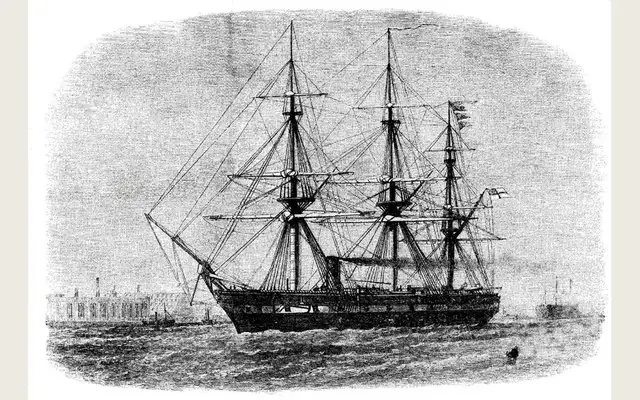
A naval vessel was reorganized for research
An ocean voyage can cross an immense area while revealing surprisingly little about what lies beneath it. The Challenger expedition sought a different relationship with the sea. Between 1872 and 1876, its crew and scientific team repeatedly stopped to measure, lower equipment, retrieve material, and record conditions. The route mattered, but so did the individual stations along it. They turned a journey into a structured investigation. The expedition's importance came not merely from visiting distant waters, but from connecting samples and observations with information that allowed them to be compared and studied afterward.
HMS Challenger began as a naval vessel and was refitted for scientific work. Most of its guns were removed, freeing space for laboratories, equipment, and collections. The conversion is an important part of the story because research at sea required a working environment, not simply scientists taking notes on an ordinary voyage. Ropes, dredges, storage, workrooms, and the skills of the crew all contributed. The vessel had to remain capable of travelling long distances while repeatedly performing operations that could be difficult, time-consuming, and vulnerable to damage in the conditions encountered offshore.
A sample needed a measured context
The expedition investigated physical conditions, seawater, seabed material, and marine life. Those subjects overlapped without being identical. A depth measurement supplied one kind of information, a temperature reading another, and a dredged specimen another again. Combining them made it possible to ask how organisms and materials related to their surroundings. A remarkable object brought up without context could attract attention, but its scientific usefulness was more limited. The record of where it was collected, at what depth, and under what conditions helped turn a curiosity into evidence that other investigators could use.
Under the scientific leadership of Charles Wyville Thomson, the expedition established hundreds of observing stations. The National Oceanography Centre records 362 in its history. A station was not a permanent building planted in the ocean; it was an organized episode of observation and sampling at a recorded location. The distinction helps explain the achievement. Repetition through comparable procedures created a body of information extending beyond any one place. The team did not need every station to produce a spectacular discovery. A series of ordinary, carefully recorded measurements could become valuable precisely because it supplied a basis for comparison.
The work continued after the voyage
Working with long lines and deep-water sampling equipment required patience and practical skill. Gear could be lost or damaged, and a successful recovery still left the task of sorting and preserving what had arrived on deck. Scientific aims depended on seafaring operations, while sailors' work created opportunities for laboratory examination. The project therefore cannot be understood only through the names of its principal scientists. Its results emerged from a shipboard organization that connected handling equipment, maintaining records, preserving specimens, navigating, and keeping the vessel capable of continuing the voyage through very different waters.
Returning to port did not complete the investigation. Specialists examined the collected organisms and materials, and extensive reports communicated the findings. The work of identification and description continued over many years. This longer sequence is essential to understanding an expedition's output. Collection is not the same activity as analysis, and a newly recovered specimen does not arrive with its place in scientific knowledge already settled. The voyage created an archive of material and observations from which researchers could develop claims, compare forms, revise classifications, and communicate results to people who had never been aboard.
Old collections became evidence for new questions
The preserved specimens also acquired uses that the original collectors could not fully anticipate. The Natural History Museum describes later comparisons between Challenger material and more recently collected marine organisms, including studies of microscopic shells. Such work shows why collections can remain useful after the first reports are published. A specimen preserves features that an earlier investigator may not have measured, while its documented context permits a new comparison. The value depends on continued care of both object and record. A label, catalogue entry, and preserved sample can together support questions that none could answer alone.
Challenger's legacy is consequently broader than a list of discoveries or a dramatic account of deep-sea exploration. The expedition helped establish ways of making the oceans investigable through coordinated measurement, sampling, preservation, and publication. Its achievements should not erase earlier maritime knowledge or the investigations that prepared the way for the voyage. They show what a large, organized research effort could add. The ship crossed the world, but its most durable work survived ashore: collections and records through which later generations could continue asking what the ocean contains and how it changes.