A thread begins with controlled drawing
Spinning requires more than making something turn. Fibres must be drawn into a suitable strand and twisted into yarn without being pulled apart. The machine associated with Richard Arkwright addressed that relationship through rollers and rotating spindles. Patented in 1769, it became known as the water frame because of its successful application with water power. The name can make the invention sound like a waterwheel fitted with a few textile attachments. Its significance was more specific: a controlled drawing process became part of a machine capable of producing strong yarn in substantial quantities.
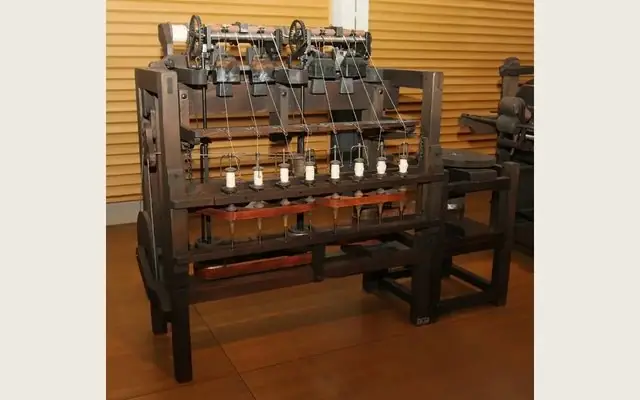
Successive rollers moved at different speeds, drawing out the cotton before the spindles twisted it. That difference in speed was purposeful. It controlled how a thicker supply of prepared fibres became a thinner strand rather than leaving the drawing entirely to a spinner's hands. The mechanism linked several actions that had to remain compatible. Too much pull or an unsuitable twist could spoil the product. The water frame therefore illustrates a form of mechanization concerned with relationships between motions, not simply with replacing muscular effort by a larger source of power.
A patent was one stage of a shared undertaking
Arkwright's achievement also involved collaborators and contested claims. The Science Museum's biographical account describes his work with the clockmaker John Kay, financial partnerships, and later testimony concerning earlier work by Thomas Highs. Kay here should not be casually confused with another inventor of the same name associated with the flying shuttle. The history does not become clearer by eliminating everyone except the patent holder. A machine developed through models, components, funding, and practical trials. Its eventual commercial identity could be attached to one name while the process that made it possible involved several people's knowledge and labor.
The 1769 patent supplied a legal description of the roller-spinning machinery. It was one stage in an enterprise whose arrangements continued to change. Investment allowed development to proceed, while partnerships determined who held shares and rights in the undertaking. A patent did not automatically create an operating mill or a dependable supply of yarn. Nor should the later success be projected backward as evidence that every investor immediately recognized an obvious future. The commercial history required persuasion, commitments of money, and decisions made while the equipment and the business around it were still developing.
Water power connected the frame with a factory
At Cromford, water power became part of a larger arrangement of machinery, buildings, and work. The partners leased land in 1771, and the site developed as an important centre of cotton spinning. Different accounts attach dates to different stages of the mill's establishment, so the essential point is the sequence rather than an artificially exact instant of transformation. A frame needed a power transmission system and a prepared material supply. A mill brought many such requirements together. The machine's productivity depended on that organized environment as well as on the rollers visible within its own structure.
This organization affected the human setting of production. Bringing machinery and power into a mill changed where work was concentrated and how activities depended on one another. A frame could not be understood only as a private invention standing on an otherwise empty floor. Workers had to prepare, feed, attend, and maintain the equipment, while a business needed to obtain cotton and sell yarn. The result linked technical capability with a wider industrial system. The familiar claim that a machine transformed production becomes more meaningful when those connections are considered rather than treating the device as an independent cause acting alone.
Reading the machine beyond a heroic portrait
Surviving objects and replicas reveal different aspects of the history. The Science Museum Group preserves a four-spindle frame dated around 1775, described cautiously as possibly the earliest surviving production example. That wording matters: an object can be exceptionally important without being confidently identified as the first machine ever made. A replica can communicate the arrangement without sharing the same provenance. The accompanying image is explicitly identified as a replica. Keeping these distinctions visible allows an illustration to explain the mechanism while the historical object and patent retain their separate roles as evidence.
The water frame's significance lies in the successful connection of controlled drawing, twisting, power, and organization. Its rollers made a particular operation repeatable; investment and mill building allowed that operation to be multiplied. The history also includes disputes over priority and rights, reminding us that technical development and ownership are different questions. Arkwright became a prominent figure because he helped create a commercially effective system around the machinery. Understanding that system gives a richer account than a portrait of one inventor beside a mysterious frame, and shows how the making of yarn became an important setting for industrial change.