Water made deeper mines difficult
A mine could contain valuable material and still be difficult to work because water accumulated faster than it could conveniently be removed. Pumping was therefore part of the practical boundary of mining, not a task separate from extracting minerals. Thomas Newcomen's atmospheric engine addressed that problem through a large, repetitive motion linked to pump rods. An engine erected near Dudley in 1712 became an important milestone in the development of useful steam power. Its achievement was not a small locomotive arriving early. It was a substantial stationary machine organized around lifting water from below ground.
Calling the machine a steam engine can encourage a misleading mental picture of high-pressure vapor pushing a piston through its working stroke. In the Newcomen cycle, steam played a different role. It entered a cylinder and was then condensed, reducing the pressure inside. Atmospheric pressure acting on the other side of the piston could consequently drive it downward. The engine used steam to create the conditions for a pressure difference. That is the central reason for the word atmospheric: the surrounding air was an active part of the process, even though it was not a conspicuous manufactured component of the machine.
Steam prepared a pressure difference
The piston was connected to one end of a rocking beam, with the pumping equipment connected to the other. As the piston moved downward, the beam transmitted motion to lift the heavy pump rods in the shaft. The return movement prepared another cycle. This arrangement made a repeated action possible without requiring a rotating output shaft of the kind familiar from later engines. The motion suited the pumping task. Judging the machine by whether it looked like a later factory engine would obscure the relationship between its mechanism and the particular work it was designed to accomplish.
Newcomen's work belonged to a sequence of investigations and earlier attempts, including Thomas Savery's steam pump. John Calley also participated in the development of the atmospheric engine. Those connections resist the idea of one person suddenly inventing every necessary principle. The accomplishment involved combining available knowledge into an arrangement that could function in industrial circumstances. Laboratory demonstrations of pressure or condensation did not by themselves drain a mine. Turning such effects into dependable repeated work required decisions about scale, construction, maintenance, and the means by which the motion would reach the pumps below.
A new machine relied on familiar trades
The engine also depended on established crafts. Masonry supported its installation, carpentry supplied structural elements, and metalworking produced cylinders, fittings, and other parts. The Science Museum emphasizes that builders had to work with the materials and skills available to them. This is an important part of the innovation rather than a sign that the machine was insufficiently modern. A practical design must be buildable. The atmospheric engine brought a new use of heat and pressure into a construction world whose trades had developed for other purposes, allowing those capabilities to be coordinated around a new source of power.
The cycle had costs as well as advantages. Repeatedly admitting steam and condensing it in the cylinder meant heating and cooling parts of the same system, contributing to substantial fuel consumption. The engine nevertheless offered a useful answer in settings where pumping capacity mattered and coal was available. An invention's value is not determined only by comparison with a more efficient machine built decades afterward. Its historical importance depends on what alternatives existed at the time and what work users could accomplish with it. Practical usefulness can precede later improvements in economy and control.
The surviving engines tell a longer story
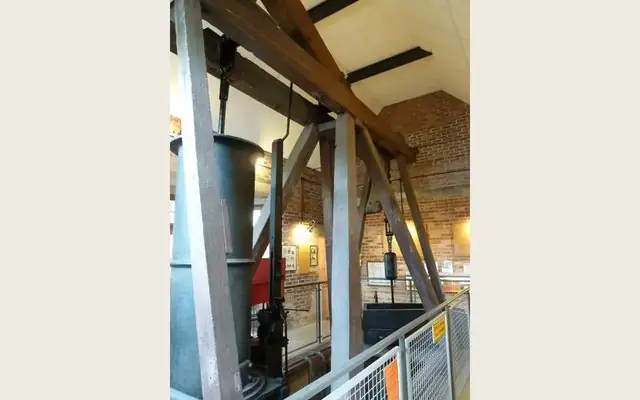
Surviving Newcomen-type engines preserve the development of the system rather than necessarily the first installation. The Science Museum's example was built by Francis Thompson in 1791 and later worked at Pentrich in Derbyshire. Its materials and alterations belong to a later period, even though its working cycle descends from the earlier design. The Dartmouth engine recognized by ASME is another descendant whose early history is not fully established. Those distinctions matter when looking at a museum photograph. An old engine can illustrate a principle without being the original object associated with the date of invention.
The atmospheric engine changed what could be attempted underground by connecting a controlled pressure difference with a demanding industrial task. Its beam, cylinder, boiler, and pumps made sense as parts of one working arrangement. The achievement is easier to appreciate when steam is not imagined as simply forcing everything forward. Condensation reduced pressure, the atmosphere supplied force, and the beam transmitted movement. Newcomen's engine made that sequence repeatable on a useful scale, drawing familiar construction skills into a machine that expanded the possibilities of mining and helped establish a new history of industrial power.