A different kind of electrical source
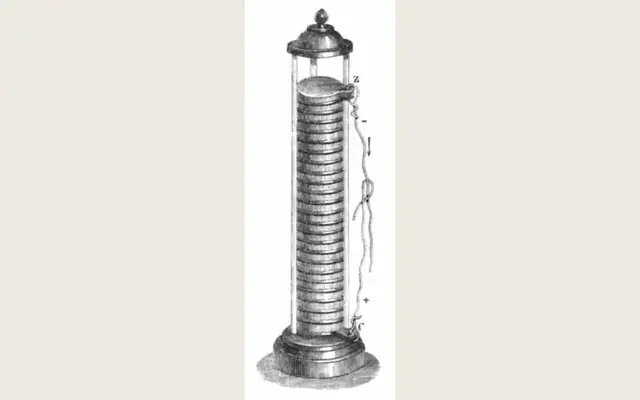
An electrical spark is dramatic, but it does not necessarily provide what an experiment needs. A brief discharge and a continuing current offer different possibilities. Alessandro Volta's pile, described in a letter dated March 20, 1800, gave investigators a practical source of sustained current. The device looked deceptively simple: a stack of unlike metal discs separated by material holding conducting liquid. Its importance lay less in an impressive appearance than in what could be done after a circuit was connected. Electricity became available for experiments that could continue beyond the instant of a spark.
The invention developed from a dispute involving Luigi Galvani's experiments with animal tissue. Movements in prepared frogs' legs raised questions about the origin of the electrical effects observed when different materials touched. Volta explored the role of unlike metals and sought an arrangement that did not require an animal specimen. The result should not be described as proof that living tissues have no electrical properties. The debate contained several questions, and a successful artificial source of current did not settle all of them. It did demonstrate that an investigator could produce an electrical effect through a different material arrangement.
Repeated layers became an experimental instrument
The pile repeated a sequence of components. Two different metals, such as zinc and silver or copper, were combined with a moist separator. Repetition built a column whose terminals could be connected through an external circuit. The separator's liquid was essential to the operation; the instrument was not merely a stack of dry metal coins. This distinction matters because the visible discs can dominate illustrations while the less conspicuous conducting liquid receives little attention. The working device depended on relationships among the materials, and leaving one of them out changes the explanation rather than simplifying it harmlessly.
Volta communicated his apparatus to Joseph Banks, president of the Royal Society in London. A description detailed enough to be reconstructed allowed the device to travel through written instructions as well as through physical examples. Other investigators could build a pile, change its arrangement, and ask their own questions. That reproducibility was a major part of its usefulness. An extraordinary effect confined to one person's laboratory would have had a different history. The pile became influential because its principle could be put to work elsewhere, producing further observations and modifications rather than remaining a single celebrated demonstration.
A working device did not settle every argument
A functioning instrument and a correct explanation of that instrument are distinguishable achievements. Volta emphasized the contact of different conductors, while later electrochemical understanding gave the reactions at the metal and liquid interfaces a central role. The historical distinction should not be erased by attributing a complete modern theory of batteries to the inventor. Nor does the theoretical limitation make the invention insignificant. The pile made new experiments possible before every aspect of its operation was understood. It supplied a productive way of investigating nature whose results could eventually challenge assumptions associated with its own creation.
The current enabled chemical investigations. In 1800, William Nicholson and Anthony Carlisle used a battery in the decomposition of water, and electrical sources became central to the emerging study of electrochemistry. Humphry Davy's later work at the Royal Institution included isolating elements such as potassium and sodium. These developments were not all discoveries made by Volta, and a historical account should keep the contributions separate. The connection lies in experimental opportunity. A new kind of electrical source allowed other researchers to arrange investigations that would have been difficult with earlier equipment supplying only intermittent discharges.
The battery opened questions beyond its first purpose
Surviving examples also require careful dates. The Royal Institution preserves a pile associated with Volta's meeting with Davy and Michael Faraday in Milan in 1814. That object provides a material link with the invention's early history, but it is not automatically the exact stack used for the first announcement in 1800. Museums preserve devices made at different stages, sometimes with changes in construction or purpose. Reading an object's provenance alongside its physical form helps distinguish an invention's first description from the later examples through which its principles circulated and its reputation developed.
Volta's pile is compelling because a modest arrangement of materials altered the practical conditions of research. It replaced the expectation of an isolated electrical event with the possibility of a continuing experiment. Its limitations remained real: it was not an inexhaustible source, and its inventor's explanation was not the final account of its chemistry. Those qualifications make the story more revealing. A device can transform science by giving people a new way to act, measure, and compare, even while the explanation of what it does remains open to further investigation.