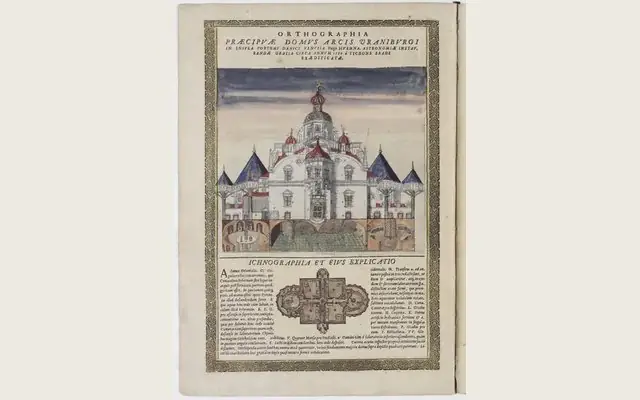
A royal grant supported an observing community
An observatory's view of the sky can depend on what happens beneath an instrument. On the island of Ven, Tycho Brahe discovered that exposure and an unstable mounting could undermine the usefulness of even an ambitious measuring device. His response included Stjerneborg, a group of partly underground observing chambers established in the 1580s near his palace-observatory Uraniborg. The arrangement can seem paradoxical: why place astronomical instruments below ground? The purpose was not to hide the sky, but to provide a steadier and more sheltered setting from which observers could measure positions within it.
Ven belonged to Denmark when King Frederick II granted it to Tycho in 1576; the island is now Swedish. Keeping those geographical contexts separate avoids turning a modern national boundary into a sixteenth-century fact. Royal patronage supported the construction of Uraniborg between 1576 and 1580. The complex combined a residence with observing facilities, a library, and laboratory space. It also brought together assistants and other workers. Astronomy here was supported through an estate and a household as well as through instruments, making the site a material and social organization for sustained investigation.
Architecture could help or hinder a measurement
The observations were made before telescopes became astronomical tools. Tycho used devices such as quadrants, sextants, and armillary instruments to determine positions with the naked eye. Large, carefully divided scales helped observers connect a sighting with an angular measurement. This was precise work without the familiar image of an astronomer looking through a long tube at a magnified planet. An instrument established a relationship between the observer, a reference direction, and the object being sighted. Its usefulness depended on construction, alignment, reading, and the procedures through which the observation was recorded.
Uraniborg's elevated observing areas provided access to the sky but also exposed equipment to practical difficulties. Wind and movement in supports could disturb a measurement. Enlarging a scale was not a sufficient answer if the structure carrying it could shift. The problem connected architecture directly with astronomy: a platform was part of the measuring arrangement rather than a neutral place on which an independent instrument happened to stand. Recognizing that relationship helps explain the development of Stjerneborg. The new facility addressed conditions of observation, showing that improving a scientific instrument can require changing its surroundings as well as its internal design.
Stjerneborg supplied a more stable setting
At Stjerneborg, founded in 1584 according to the astronomical heritage account, instruments occupied sheltered chambers with more stable foundations. Openings and covers allowed observations while reducing exposure when the equipment was not in use. The underground arrangement did not mean every part of every instrument was invisible beneath the earth. It meant that substantial parts of the observing environment could be anchored and protected. The distinction turns an odd-looking architectural feature into an intelligible response to a scientific requirement: keeping the relation between instrument and reference direction sufficiently steady for the intended measurement.
The facilities also allowed several people to observe and keep records. The Swedish National Property Board's history emphasizes the community of students and assistants and the opportunity for independent observations. Repeated measurements could be compared rather than treated as isolated impressions. A good instrument therefore needed a record-keeping practice around it. The observing journal and catalogue helped turn a particular night's work into information usable on another occasion. The scientific value was produced through this connection between equipment, trained attention, written records, and the capacity to revisit a result after the object had moved from the observed position.
Ruins and printed images preserve different evidence
Tycho left Ven in 1597, and the buildings were subsequently dismantled. The surviving archaeological remains and reconstructed landscape do not constitute a palace preserved intact from his working years. Printed depictions provide another kind of evidence, showing arrangements that the ruins alone cannot fully communicate. Conversely, an engraving presents a selected representation rather than a transparent window into every aspect of daily activity. Comparing the site, images, and descriptions gives a stronger historical account than relying on any one of them. Scientific heritage can survive through a dispersed combination of fabric, illustrations, objects, and records.
The move toward sheltered observing chambers captures a fundamental feature of Tycho's enterprise. Better astronomy required more than a clever scale or a determined observer; it required attention to the conditions that made a reading dependable. Uraniborg and Stjerneborg show that work at the scale of architecture. A royal estate supplied resources, a community sustained observations, and foundations and walls helped stabilize the instruments. The island's observatories are compelling because they make that combination visible. Looking upward depended on organizing the ground, the buildings, and the people from which the observation began.