A rural field offered something a city could not
The story of Jodrell Bank began with a search for a quieter place to experiment. In 1945, Bernard Lovell moved radar equipment from Manchester to university-owned land in rural Cheshire. Electrical interference from the city's trams had frustrated work near his laboratory. The country site offered a practical advantage, not simply an attractive setting. Radio astronomy would make the quietness of the electromagnetic environment part of the observatory's scientific resources. The familiar giant dish came later, growing from experiments whose initial equipment looked very different from a permanent astronomical landmark.
Lovell brought experience from wartime radar work to a new set of research questions. Early investigations intended to study cosmic rays instead revealed echoes associated with meteors. Scientists and technicians developed instruments, frequently adapting surplus equipment, while the site's purpose evolved through the results. This sequence matters because it avoids treating Jodrell Bank as the execution of a complete plan established on its first day. A field station became an observatory through experimental work. What the equipment detected helped determine which equipment should be built next and which problems the researchers could usefully pursue.
From improvised aerials to a steerable dish
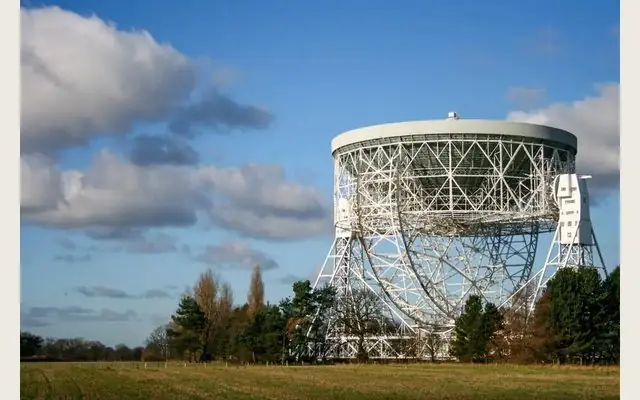
The ambition for a much larger, fully steerable radio telescope took shape around 1950, with engineer Charles Husband producing early drawings. A steerable dish could be directed toward different parts of the sky rather than relying only on sources moving through a fixed instrument's observing region. That capability required a structure whose size and movement could coexist with scientific precision. The challenge was not merely to build a large metal bowl. It was to support and control a collecting surface so that weak radio signals could be associated with particular directions and investigated through repeatable observations.
Construction began in 1952 and ran into delays, design changes, and financial difficulties. The telescope's seventy-six-metre dish made the enterprise conspicuous even before it became operational. Large scientific projects can attract attention while their eventual usefulness remains uncertain to those paying for them. The institutional history records that the project was heavily over budget by 1957. Its scientific ambition had become entangled with questions of credibility and support. Those circumstances form part of the instrument's history because the ability to complete and operate a telescope depends on maintaining an organization around it, not only on overcoming structural problems.
Sputnik changed the public meaning of the project
The launch of Sputnik 1 in October 1957 suddenly gave the near-complete instrument another public significance. Jodrell Bank tracked the carrier rocket associated with the satellite's launch, demonstrating a capability relevant to the emerging space age. The distinction between satellite and carrier rocket matters: a short retelling can merge them into one object and lose what the historical accounts specify. The event did not mean that the telescope had been conceived solely to track Sputnik. Instead, a research facility built for broader astronomical purposes proved useful in a new situation that sharply changed how its value was perceived.
The Mark I telescope, later named the Lovell Telescope, also needs to be understood as a radio instrument. Radio waves are electromagnetic radiation, not sounds travelling through space to an enormous ear. The dish collects and directs that radiation toward receiving equipment, and observations require interpretation through measurements. Its distinctive outline can encourage misleading everyday analogies, but its role becomes clearer when the visible structure is connected with electronics, controls, and analysis. The great dish supplied one part of the observing system; the information came from the relationships among all those parts and the questions asked of their results.
More than one telescope in a field
The wider observatory preserves evidence beyond its largest telescope. Early equipment, modest research buildings, control facilities, and later instruments record different stages in the development of radio astronomy. UNESCO's 2019 inscription recognized that technological ensemble, not simply a spectacular object separated from its setting. This is particularly useful for understanding experimental science. Temporary or improvised arrangements can be historically important even when later structures make them look small. Their remains help explain the route from an initial investigation to an ambitious observatory, including approaches that were modified or abandoned as knowledge and equipment changed.
Jodrell Bank's history joins continuity with surprise. Radar experience and reused machinery supported experiments that led in directions their first users had not fully anticipated. The large telescope then gained an urgent role during the beginning of the space age while contributing to a wider astronomical program. None of that makes its financial difficulties or engineering changes incidental. They reveal the conditions under which a new way of studying the universe became possible. The landmark dish stands at the centre of the story, but the quieter field, the earlier instruments, and the people who turned signals into evidence belong within the same view.