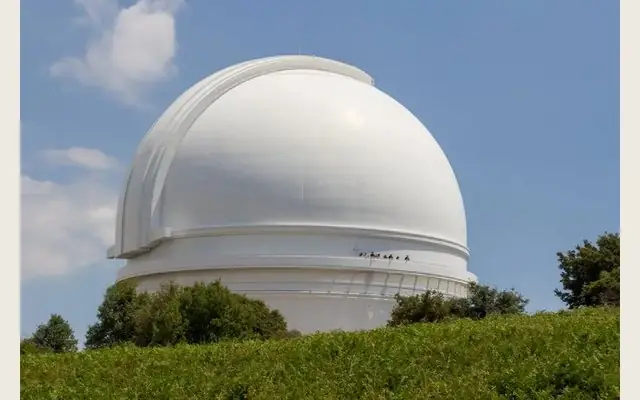
A telescope that outlived its champion
On June 3, 1948, a dedication ceremony celebrated Palomar Observatory and its enormous 200-inch telescope. The instrument was named for George Ellery Hale, who had died a decade earlier after championing the project. Yet the ceremony did not mean that every optical and mechanical problem had been resolved. First light followed in 1949, and routine observing came later still. These dates describe stages of one enterprise rather than conflicting accounts of its completion. Palomar offers a particularly clear example of the distance between building a scientific monument and commissioning a dependable research instrument.
Hale secured major financial support in 1928, setting in motion work that required astronomers, engineers, opticians, industrial firms, and builders. The Depression and the Second World War formed part of the circumstances through which the project advanced. Its history therefore resists a simple image of an astronomer ordering a larger telescope and waiting for delivery. A new capacity for research had to be created through coordinated institutions and specialized labor. The telescope would bear Hale's name, but its realization depended on people who continued solving problems long after its principal advocate could take part.
A large mirror needed a precise shape
The primary mirror made those problems especially tangible. A reflector gathers light with a curved surface, and the quality of that surface determines how effectively the light can be brought together. The Hale mirror used a large Pyrex glass disk with a thin reflective coating of aluminum. Its five-metre scale made the manufacturing task formidable. A successful blank was only a starting point: the glass still had to be ground, polished, and figured. A very large piece of material could become an optical instrument only if its final shape met requirements far more exacting than its impressive diameter suggested.
The mirror also needed support in the telescope. Gravity acts on glass as on other materials, and a surface tested in one arrangement may behave differently when installed and pointed around the sky. The mount, mirror cell, and optical surface consequently belonged to the same practical problem. Precision was not simply something applied to the glass in a workshop and preserved automatically afterward. The telescope had to maintain useful relationships between its parts while moving. This is why a completed dome and an installed mirror could be visually convincing signs of progress without being sufficient evidence of readiness for unrestricted research.
Dedication and first light were different milestones
Work continued around the 1948 dedication. Caltech's history describes further adjustment after installation, while Allan Sandage's retrospective distinguishes the ceremony from the release of the telescope for scheduled scientific use. Edwin Hubble made the celebrated first-light exposure of NGC 2261 in January 1949. That image marked another significant step, but one successful exposure did not make commissioning unnecessary. The sequence helps explain a recurring feature of scientific infrastructure: different milestones answer different questions. Naming, installation, first light, and the beginning of a regular observing program need not occur on the same day.
The instrument also needed to follow objects as Earth turned. Collecting light over an exposure requires the telescope to maintain the intended pointing, while the mount carries substantial mass and the instruments impose their own requirements. The Hale's equatorial arrangement and carefully balanced moving structure addressed that task. Its size is impressive, but the more revealing achievement is controlled movement. A giant telescope that could be pointed only approximately would not supply the observations for which it had been built. Mechanical behavior and optical performance therefore had to be evaluated as connected parts of the same system.
The useful instrument was a whole system
Different arrangements of mirrors can direct collected light toward different focal positions and scientific instruments. This versatility helped make the telescope more than a large camera permanently fixed in one configuration. Imaging and spectroscopy ask different kinds of questions, and the equipment receiving the light can change as methods develop. The telescope's long historical importance cannot be explained by aperture alone. It also depended on the capacity to connect that aperture with instruments, observing procedures, and research programs capable of making useful measurements. Building a major facility creates possibilities whose value is realized through subsequent work.
Palomar's commissioning story makes its achievement more substantial, not less. The dedication honored an extraordinary collective effort, while continued adjustment acknowledged that scientific usefulness demanded further proof. The telescope had to become repeatably capable of doing the work its appearance promised. Remembering those stages gives a fuller view than a single completion date or a former size record. The Hale Telescope emerged through a succession of material and organizational problems, and its transition from celebrated construction project to research instrument depended on treating the remaining imperfections as questions to be investigated rather than reasons to stop looking.