A remarkable instrument in an Irish estate
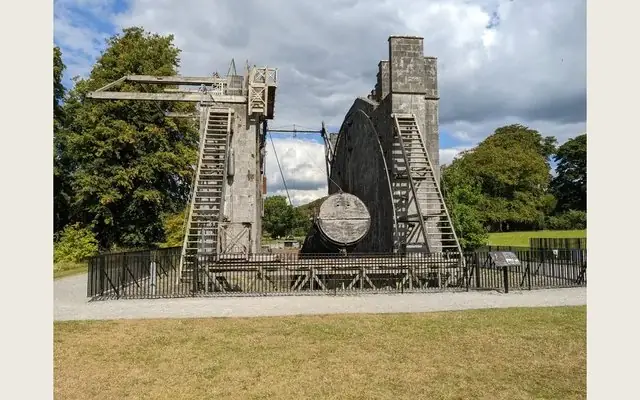
In 1845, an enormous reflecting telescope was completed at Birr Castle in Ireland. Known as the Leviathan of Parsonstown, it used a mirror six feet across, far larger than the mirrors most astronomers could access. William Parsons, the third Earl of Rosse, directed the enterprise from his estate, drawing on workshops and skilled labor as well as astronomical ambition. The instrument's size attracted attention, but its scientific significance depended on what that size could make visible. Faint patches in the sky offered questions whose answers required more than a striking telescope standing between tall walls.
Birr was not the first stage in Parsons's work. He had already developed techniques for smaller reflecting telescopes before attempting the great instrument. This sequence matters because a six-foot mirror could not be obtained simply by ordering an enlarged version of a familiar household object. Casting, grinding, polishing, supporting, and moving it presented linked problems. Knowledge accumulated through earlier attempts and through the work of people trained in the estate's workshops. The telescope was therefore both an observational facility and the result of a substantial local manufacturing effort whose products had to meet unusually exacting requirements.
The mirror was a manufacturing problem
Its mirror was made from speculum metal, an alloy principally of copper and tin, rather than glass carrying a thin reflective coating. The Science Museum preserves a surviving example, weighing more than four tonnes with its associated assembly. The material could be polished to reflect light, but it also tarnished. Maintenance consequently affected observations directly. A large collecting surface did not guarantee good results if its reflective condition had declined. Polishing was not a minor cosmetic activity. It belonged to the continuing work required to turn the instrument's potential into a useful view of the sky.
The long tube was suspended between massive masonry walls. This arrangement provided support but restricted movement compared with a telescope capable of pointing freely throughout the sky. Objects could be observed within a limited region as Earth's rotation carried them through the available field. The relationship between aperture and mounting is important here. A bigger mirror expands some possibilities while the support system constrains others. Describing the Leviathan only through the diameter of its reflector would miss the practical circumstances under which observers had to find an object, position the instrument, and make the most of the observing interval.
Seeing a spiral did not settle every question
Nebulae were among the central targets. The term covered objects whose physical nature was not yet understood in the way it is today. Parsons and other observers identified spiral forms in some of these faint patches, producing drawings that made the structures available to people who could not look through the telescope themselves. Recognizing a shape was a significant observation, but it did not by itself establish every part of the modern account of galaxies. A careful history distinguishes the feature seen at the eyepiece from the later understanding of what kind of object displayed that feature.
The drawings also remind us that observation involved interpretation and recording. Before a photographic exposure could be treated as the routine output of such an instrument, a person had to inspect a faint view and communicate what seemed significant. Atmospheric conditions, the mirror's state, and the observer's experience all affected that task. A drawing was neither a simple photograph produced by hand nor an invention unconstrained by evidence. It was an attempt to preserve an observation in a form that could be examined, discussed, and compared with other views of the same celestial object.
A scientific object with a later life
The instrument's later history separated parts of the original enterprise. The great mirror entered the Science Museum's collection, while structures and subsequent restoration at Birr preserved another way of encountering the telescope. These different survivals should not be mistaken for a single object left unchanged since its first observations. A museum mirror can reveal material, scale, and support details; the site communicates the physical arrangement and the landscape of the undertaking. Together they supply complementary evidence. Preserving scientific heritage often means following components and records through different later lives rather than expecting everything to remain in one place.
The Leviathan's story is most revealing when its spectacle and its limitations are kept together. The great aperture helped observers recognize features that smaller instruments could not readily show, while the mirror, mounting, weather, and methods determined how that opportunity was used. Its achievement was a new capacity to investigate, not an instant solution to every question about the objects observed. At Birr, an ambitious manufacturing project became a means of seeing the universe differently, and the surviving mirror and records preserve the demanding material work behind that change in view.