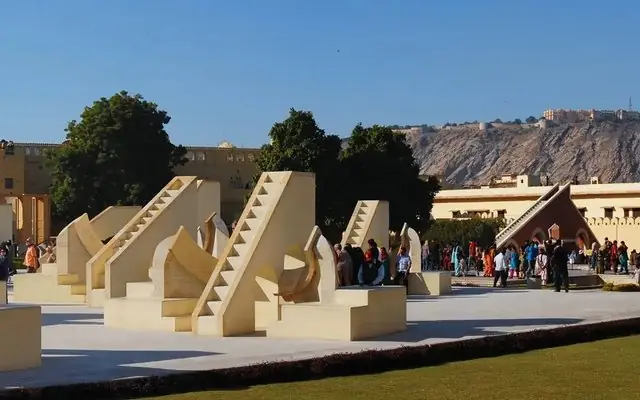
An observatory without a telescope dome
An observatory need not begin with a dome enclosing a telescope. At Jaipur's Jantar Mantar, monumental structures in an open enclosure were themselves astronomical instruments. Their curves, planes, openings, and graduated surfaces translated positions in the sky into quantities an observer could read. Built under the patronage of Sawai Jai Singh II in the early eighteenth century, the site belongs to a history of measurement conducted with the naked eye. Its scale can make it resemble a collection of abstract buildings, but the forms were organized around specific tasks rather than around appearance alone.
Jai Singh's observatory formed part of a wider program involving several sites in northern India. Jaipur provided a particularly extensive ensemble within the ruler's capital. The project drew on traditions of positional astronomy shared across cultures, including the mathematical problem of describing where a celestial body appears relative to an observer. That context prevents two misleading interpretations. The instruments were neither mysterious devices whose operation lies beyond explanation nor isolated inventions unrelated to earlier knowledge. Their achievement involved bringing astronomical understanding, local construction, and royal support together in a carefully organized setting for observation.
Geometry translated into masonry
The large Samrat Yantra is the most immediately recognizable example. It uses the relationship between the Sun and an inclined central structure to cast a shadow onto graduated surfaces. Reading the shadow gives local solar time. The principle is related to that of smaller sundials, but the monumental dimensions make the geometry physically conspicuous. A visitor can see a mathematical relationship expressed across masonry. The scale did not turn the instrument into an automatic clock: its usefulness still depended on orientation, the condition of the marked surfaces, and an observer who understood what the shadow represented.
Other instruments addressed different coordinates and observing arrangements. The Ram Yantra used open cylindrical forms with a central element to measure altitude and azimuth, describing the height and direction of an object in the sky. The Jai Prakash used concave surfaces divided by markings, providing another way to represent the celestial sphere. These were complementary approaches rather than decorative variations on one enormous sundial. Together they show why the site should be understood as an ensemble. Different geometries made different relationships readable, allowing observation to be organized through more than one physical arrangement.
Measurement required more than a large scale
Large dimensions can make a small angular difference occupy a longer distance along a scale. That advantage is understandable without assuming that size by itself guarantees a particular accuracy. Shadows have edges, surfaces must be maintained, and the placement of an instrument affects every reading taken from it. Astronomical observation therefore connected construction with procedure. A precisely intended curve could not compensate for a scale that had deteriorated or a reading made without the necessary care. The observatory's masonry mattered because it established the framework within which people observed, compared, and interpreted the changing sky.
Local solar time also needs to be distinguished from the standardized time shown on a modern phone. A sundial responds to the Sun as observed at its location; civil time belongs to a broader system of agreed reference meridians and timekeeping conventions. The distinction helps explain the instrument's historical purpose without treating a difference from a wristwatch as evidence that it is defective. The question is what quantity was being measured. Reading the observatory as a scientific site means asking that question before comparing its results with tools designed for different social and technical arrangements.
Preserving a working idea in stone
The surviving site has undergone restoration, making conservation part of its history. Its World Heritage inscription in 2010 recognized the importance of the fixed monumental instruments and the knowledge they embodied. Preserving such a place involves more than maintaining visually attractive walls. Scale markings, alignments, and relationships between surfaces contribute to the explanation of how an instrument worked. At the same time, restoration must be understood as intervention in inherited fabric. The appearance of the site today cannot simply be projected backward as though every surface had remained untouched since Jai Singh's astronomers used it.
Jantar Mantar offers an unusually direct encounter with the material form of calculation. An astronomical coordinate becomes a curve; a changing direction becomes a shadow crossing a scale; a mathematical model acquires dimensions large enough to walk around. Its fascination is not dependent on making extravagant claims about lost technology. The achievement is visible in the connection between an idea and a usable structure. In Jaipur, the sky was studied through an observatory whose instruments occupied the ground as architecture, while still requiring the attention and knowledge of the people who read them.