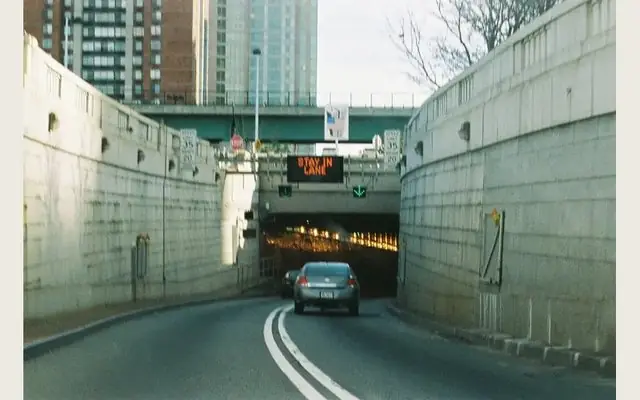
A route beneath a working river
A road beneath the Hudson River promised a journey that did not require waiting for a vehicle ferry, but digging a passage was not enough. Cars and trucks brought engines into a long enclosed space, where their exhaust could accumulate. The Holland Tunnel therefore posed two closely connected engineering problems: how to construct tubes beneath a navigable river, and how to make the environment inside those tubes suitable for motor traffic. When it opened on November 13, 1927, its ventilation system was part of the achievement, not a minor service added after the difficult engineering had finished.
The crossing linked Manhattan and Jersey City through two tubes. Construction took place between 1920 and 1927, with the work passing through successive stages of engineering leadership. Clifford M. Holland, the project's first chief engineer, gave the tunnel its name; Milton H. Freeman and Ole Singstad also played major roles. A history that names only one of them risks making a complex enterprise appear to be an individual's completed design carried out without change. The tunnel required investigation, construction management, mechanical design, and the coordination of many people working under difficult conditions.
Excavation was only part of the challenge
Excavating beneath the river meant controlling the relationship between the working space and the surrounding water-bearing ground. Shields protected the advancing work area, and pneumatic methods helped make construction possible in demanding river-bottom conditions. The route also avoided placing a permanent obstruction in the shipping channel above. That distinction connects tunnelling with the wider transport landscape. A crossing designed for motor vehicles had to coexist with vessels using the Hudson, and the means of construction had to respect that navigable waterway as well as the streets and approaches at either end.
Once a tube had been excavated and lined, the problem of its atmosphere remained. Engine exhaust could not be treated as a small inconvenience to be dispersed whenever traffic happened to move. The enclosure, length, and changing concentration of vehicles made ventilation a design requirement. The historical engineering accounts emphasize extensive testing, including work associated with the United States Bureau of Mines. This connection between physiological investigation and mechanical design is especially revealing. Understanding the machinery required understanding what the machinery was intended to control: the conditions experienced by people travelling or working inside the tunnel.
Fresh air supplied across the tunnel
The resulting system supplied fresh air at roadway level and removed exhaust-laden air through the ceiling along the tunnel. Ducts distributed the movement across the route rather than relying only on air entering one portal and eventually reaching the other. That distinction made the tunnel a coordinated mechanical environment. The visible roadway occupied only part of its functional section; spaces for supply and exhaust were also essential. A driver could experience the route as a simple tube while the infrastructure supporting that experience extended above, below, and beyond the traffic lanes.
Four ventilation buildings housed eighty-four large fans, divided between supply and exhaust. The historical landmark brochure describes the system's ability, at full capacity, to change the tunnel air in about ninety seconds. That figure describes a capacity, not a claim that every fan must always operate at maximum speed. Monitoring and control were integral to the arrangement. Air conditions and equipment operation had to be observed so that the system could respond to demand. The fans alone did not make the design effective; their connection to ducts, measurements, controls, and operating decisions made them part of a usable system.
A crossing whose machinery stayed essential
The ventilation buildings made the tunnel's mechanical needs visible at the surface. They were connected to a route whose users might never see the fans or ducts maintaining its air. This separation between visible service and supporting equipment is a useful way to understand the crossing. A tunnel portal identifies where vehicles enter, but it does not show everything required to keep the route operating. Buildings, machinery, and staff outside the traffic lanes remained linked to conditions within them. The crossing therefore extended functionally beyond the tubes themselves, joining construction beneath the river with facilities on its shores.
The Holland Tunnel's significance extends beyond a shorter crossing time. It showed how a major road route beneath water could be designed as an environment requiring continuing mechanical support. Its ventilation buildings are therefore as relevant to the story as its portals and roadway. The opening ceremony marked the beginning of an operating responsibility, with inspection and maintenance remaining essential afterward. Looking at the tunnel through its air system changes the familiar image of infrastructure. The important achievement was not merely making a space through which vehicles could pass, but organizing the conditions that allowed that passage to become practical.