Two kinds of traffic needed the same place
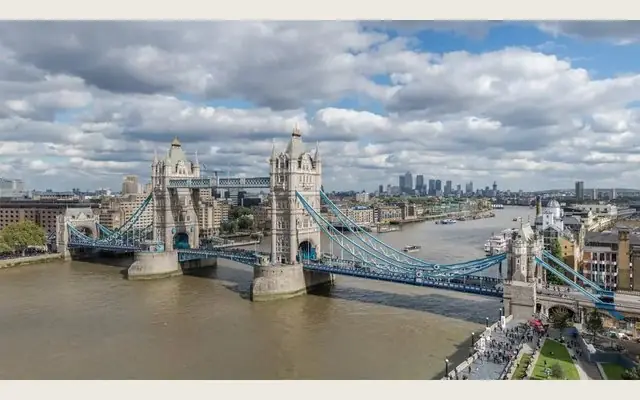
Tower Bridge's most important feature is an interruption. The roadway that appears to make a permanent connection across the Thames can divide at the centre and rise, allowing vessels to pass through. Opened ceremonially on June 30, 1894, the bridge answered competing needs in a busy port city. People and vehicles required another crossing, while ships still needed access to the river upstream. The solution was not to give one kind of traffic complete priority in the structure's design. It was to make a crossing that could change its configuration when the waterway required it.
The bridge combined architecture and engineering. Horace Jones supplied architectural design, while John Wolfe Barry was responsible for the engineering enterprise that carried the project forward. Construction lasted from 1886 to 1894. Its two main towers and high-level walkways created the outline now associated with London, but the historic appearance should not obscure the metal structure and machinery within. The stone cladding gave the bridge a monumental architectural character. Underneath that character lay a working crossing whose materials and mechanisms belonged to the industrial world of the late nineteenth century.
A moving roadway inside a monumental bridge
The central opening is formed by two bascules, the leaves of the movable roadway. Each rotates rather than lifting vertically as a single platform. Counterweights help balance the moving sections, reducing the effort needed to raise them. The chambers beneath the roadway provide space for those counterweights as the leaves move. A photograph of an opening bridge captures only the visible half of that action. Understanding the hidden space changes the picture: the roadway rising above the river is linked to machinery and masses moving out of sight below it.
The bridge is also more than its central bascules. Suspended approach spans connect the towers toward the banks, and the high-level walkways link the towers above the movable roadway. Historic England's listing identifies this combination of moving span, suspended approaches, and elevated footbridges. Each element helps address a different part of the crossing. Reducing the whole structure to a pair of decorative towers would leave its practical organization unexplained. It is the relationship between permanent supports and moving central leaves that allows the bridge to remain a recognizable monument while temporarily opening a route for shipping.
Stored energy and the original machinery
The original machinery used steam and hydraulics in different roles. Steam engines powered pumps, which pressurized water in accumulators. Those accumulators stored energy so that it could be released when a lift was required. Hydraulic drive engines then turned gearing connected to the bascules. This sequence matters because the bridge did not have to begin raising steam from nothing each time a ship approached. Stored hydraulic energy linked a relatively steady preparation process with an intermittent demand for movement. The engine rooms were therefore part of a system, not simply a collection of impressive engines beside an otherwise independent bridge.
The final construction period included testing and preparation as well as architectural finishing. The official timeline records weight testing of the bascules in June 1894, before the royal opening. It also distinguishes that ceremony from stages of wider public use in July. That distinction is useful because a ceremonial date does not automatically describe every aspect of a new structure's operation. The bridge had to be staffed, controlled, and integrated into road and river routines. Machinery could make the opening possible, but repeated service depended on people organizing when and how the movement took place.
A changed power source and a continuing purpose
In the twentieth century, changes in shipping and the geography of London's port altered the demands placed on the bridge. A new electro-hydraulic system was installed during the 1970s, with the conversion completed in 1976. Electric pumps and oil hydraulics replaced the steam-powered water-hydraulic arrangement. The change preserved the essential act of raising the bascules while changing the equipment that supplied the power. The original engines consequently became evidence of an earlier operating system. Their survival helps visitors understand a stage of the bridge's history that is no longer identical to its everyday means of operation.
Tower Bridge makes sense when its architecture and machinery are considered together. The towers establish a monumental presence, while the opening roadway reveals the compromise that justified building the crossing in this form. Its history is not simply a story of ever larger structures overcoming a river. It is a story of accommodating different uses of the same space, with machinery allowing the arrangement to change. The celebrated moment when the bascules rise is therefore not a departure from the bridge's purpose. It is one of the clearest demonstrations of what the bridge was built to do.