Reading more than points of light
A photograph of a star need not show only a point of light. When starlight is dispersed through a prism, it produces a spectrum whose lines carry information about the star. At Harvard College Observatory, glass photographic plates preserved vast numbers of these traces. Their scientific usefulness depended on somebody recognizing patterns, distinguishing similar cases, and applying consistent categories. Annie Jump Cannon became exceptionally skilled at that work. Her achievement was not merely to accumulate a large number of classifications, but to help make an archive of individual observations into a system other astronomers could use.
Born in Delaware in 1863, Cannon studied physics and astronomy at Wellesley College, where Sarah Frances Whiting was an important teacher. After graduating in 1884, she also developed a strong interest in photography. She returned to scientific study in the 1890s and joined the Harvard observatory's staff in 1896. This combination of experience matters. Photographic material was both a medium she understood and a scientific record requiring interpretation. Her career unfolded in an institution that employed women for substantial analytical work while offering them more restricted professional standing than the importance of that work might suggest.
A classification that could be applied repeatedly
The plates did not present the bright rainbow familiar from modern educational illustrations. Harvard's account describes greyscale spectra examined with a lightbox and magnifying glass. Cannon compared the appearance and intensity of their lines, working within and revising earlier systems. Williamina Fleming's classifications formed part of that background. A new scheme therefore emerged through modification and selection rather than through an isolated invention with no predecessors. Categories had to be recognizable across different observations, detailed enough to preserve useful differences, and practical enough to apply to a collection far larger than a handful of striking examples.
The sequence O, B, A, F, G, K, M became the familiar core of the Harvard system, with numerical subdivisions providing additional precision. Its apparently irregular lettering reflects the history of rearranging existing categories. The sequence is understood as an ordering by stellar temperature, but identifying a pattern and explaining its physical basis are distinguishable contributions. Cannon's first catalogue appeared in 1901. The classifications gave subsequent researchers a stable language through which to compare spectra, ask physical questions, and connect particular stars with a wider population rather than treating every photograph as a separate curiosity.
A catalogue and the people behind it
Large catalogues require persistence as well as an organizing idea. The Henry Draper Catalogue and its extensions drew on photographs, record keeping, checking, and the labor of several people. Cannon's classifications operated within that larger enterprise under observatory director Edward Pickering. The result made many observations accessible beyond the immediate room in which they had been examined. A catalogue can look impersonal because it is arranged as entries rather than a narrative. Its reliability nevertheless rests on human decisions about consistency, borderline cases, and the information a future reader needs in order to use an entry intelligently.
Cannon's role also extended beyond her own measurements. Harvard's archival account describes her mentoring of colleagues and the social life around the observatory, including visitors recorded in a guestbook. These activities were not substitutes for scientific work; they were part of the environment in which people exchanged knowledge and maintained a research community. She also supported women's suffrage. Her interests remind us that the person behind a classification system did not exist only at a desk. Photography, professional friendships, public activity, and scientific judgment belonged to the same working life without being reducible to one another.
Recognition that followed decades of work
Institutional recognition arrived unevenly. Cannon became curator of astronomical photographs in 1911, but her regular Harvard appointment as William C. Bond Astronomer came only in 1938, near the end of her career. She also received major honors from scientific and academic organizations. Those achievements should be read beside the limits under which women worked, not as evidence that the limits had disappeared. The delay between performing valuable scientific labor and receiving a formal position is part of the history of the catalogue, because institutions shape whose contributions become visible and how they are described.
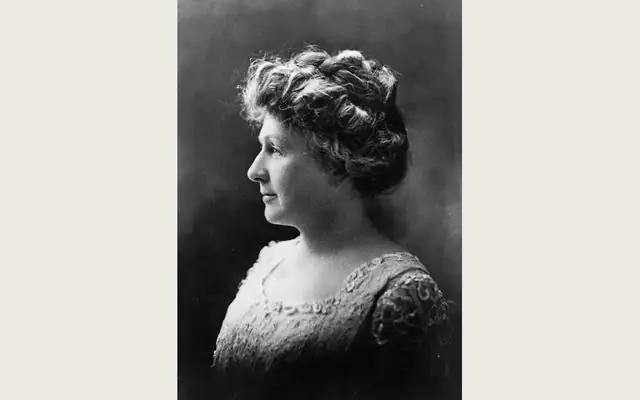
Cannon died in 1941, leaving both a body of classifications and records of the practice that produced them. The accompanying historical portrait places a face beside the familiar astronomical letters, but the deeper legacy lies in a method of comparison. A usable classification creates possibilities for discoveries its maker may not yet be able to predict. By turning subtle photographic differences into repeatable categories, Cannon helped give other researchers a starting point for explaining stars. Her story shows how patient work with existing observations can change a science as profoundly as obtaining a dramatic new image of the sky.