A landscape becomes a question
A geological landscape can conceal the history of its own materials. Rocks altered by heat, pressure, and time may no longer resemble the conditions under which they first formed. Florence Bascom made the investigation of such problems central to her scientific career. Her work joined microscopic examination with observation in the field, using evidence at different scales to reassess the origins of ancient rocks. She also helped establish a strong program of geological teaching at Bryn Mawr College. Research and education were closely connected: students had to learn how to turn samples and landscapes into arguments rather than merely memorize names.
Bascom was born in Massachusetts in 1862 and grew up in a family that encouraged education. At the University of Wisconsin she earned degrees in arts and science, followed by a master's degree in geology in 1887. Opportunities remained constrained despite that support. Access to classes, facilities, and professional expectations differed for women. Her subsequent admission to Johns Hopkins University required backing from established academics. These circumstances shaped a route into research that cannot be described simply as moving through a sequence of available qualifications. The qualifications themselves had to be pursued within institutions that did not offer equal terms.
Training to recognize rocks with a different history
In 1893 she became the first woman to receive a doctorate from Johns Hopkins. Her research involved rocks whose origins had been interpreted incorrectly. Material thought to be sedimentary could instead preserve the altered remains of ancient volcanic activity. Recognizing that history required more than judging a weathered surface by appearance. Petrography brought microscopic evidence into the investigation, while field relationships helped place the samples within a larger geological setting. The value of the interpretation lay in connecting those observations. A tiny feature in a specimen could change the account given of a much larger body of rock.
This relationship between scales helps explain why fieldwork was essential to her practice. A sample carries information about its composition and texture, but removing it from its setting can also remove relationships needed to understand it. Position, neighboring formations, and structures visible across an area contribute another kind of evidence. Conversely, a broad landscape view cannot settle every question about the history of a particular rock. Bascom's work moved between those limits. The laboratory and the field supplied different constraints, and a stronger geological interpretation had to satisfy both instead of treating either one as sufficient on its own.
Research that moved between field and laboratory
She joined Bryn Mawr in 1895 and developed its geology program, building collections and opportunities for students to undertake serious study. In 1896 she became the first woman employed by the U.S. Geological Survey. The connection gave her access to professional colleagues and resources while also creating a demanding rhythm of work. Field seasons, sample analysis, mapping, reports, and teaching occupied different parts of the year. The appointment was therefore not merely an honor added to an academic biography. It supported an active research practice whose results had to be communicated in forms usable by other investigators.
Her maps and studies addressed areas including the Appalachian Piedmont and neighboring regions. The National Park Service also records her investigation of Mount Desert Island and a report published in 1919. Such work made individual observations part of an account that could be revisited. A geological map is not simply a decorative picture of terrain. Its boundaries and descriptions express judgments about the distribution and relationships of materials. Producing it requires selecting evidence, evaluating continuity, and communicating uncertainty well enough that another reader can understand what is claimed and decide where further observation might be necessary.
Building a place for the next investigators
At Bryn Mawr, taking students into the field could conflict with expectations about appropriate activity and clothing for women. Institutional accounts preserve discussions about those restrictions. Bascom nevertheless emphasized excursions and rigorous training, helping students prepare for research careers rather than treating geology only as an agreeable accomplishment. The later achievements of geologists she taught form part of her influence. A teacher's contribution can extend through methods and standards carried into other institutions. That kind of legacy is less easily represented by a single discovery date, but it can have lasting consequences for who is able to investigate a scientific problem.
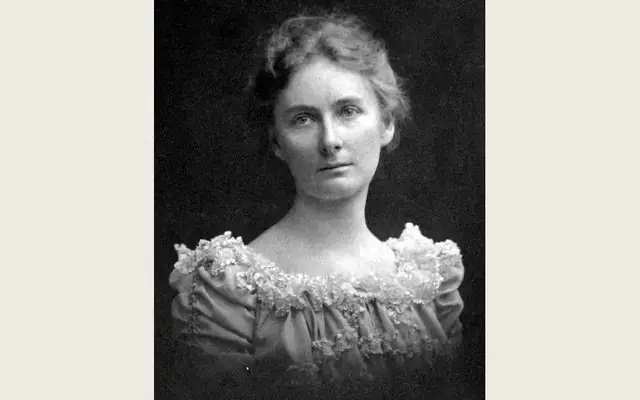
Bascom's career is often presented through a list of firsts. Those milestones matter, but they become more revealing when connected to the actual work that followed them. Admission made research possible; employment supported surveys; teaching created additional investigators capable of pursuing the questions. Her portrait supplies a recognizable person behind the publications, while the maps and rock studies show what professional participation required. The enduring story is one of connections: between a mineral texture and a landscape, between observations and an interpretation, and between a scientist's own opportunities and the demanding education she helped make available to others.