Looking into a planet without reaching its center
The interior of Earth cannot be investigated in the same way as an exposed rock face. Its deepest regions lie far beyond direct sampling, so investigators have to interpret signals that have travelled through them. Inge Lehmann's work illustrates how much can be learned from a signal that appears where a model says it should not. In 1936 she proposed an inner region within Earth's core to explain otherwise puzzling seismic observations. The reasoning did not begin with a view of that region. It began with records of movement at distant stations and a problem in the explanation of their arrival.
Lehmann was born in Denmark in 1888 and trained in mathematics. In the 1920s she joined work associated with the Danish geodetic institute, helping develop and operate seismological observations. The network included stations in Denmark and Greenland. These institutional duties placed her close to the records from which the later insight emerged. Running a service and interpreting its measurements were connected activities, not completely separate kinds of work. Knowledge of instruments, the quality of observations, and the differences between stations could matter when deciding whether an unusual trace represented a meaningful event or a problem in the record.
An observation in the wrong place
Earthquakes produce different kinds of seismic waves. P-waves involve compression and can travel through solids and liquids, while S-waves behave differently and do not propagate through a liquid in the same way. Their paths and arrival times provide information about conditions within the planet. A change in material properties can bend a wave's path, so observations around the globe can reveal boundaries that nobody can inspect directly. By the early twentieth century, the existence of a liquid core explained important features of the observations. It did not, however, account satisfactorily for every faint arrival recorded in supposedly shadowed regions.
Records associated with a large New Zealand earthquake in 1929 sharpened that difficulty. Some P-waves were detected where the working model did not predict them. Such observations could be treated as troublesome exceptions, but Lehmann considered what kind of structure would make them intelligible. The question was not simply whether an earthquake had occurred. It was how its waves had travelled through Earth and why a small part of the signal followed a different history from the one the existing picture allowed. Weak evidence became significant because of its relationship to a specific physical prediction.
A new model and the questions it left open
Her 1936 paper, titled P′, proposed an additional region inside the core in which the velocity of the waves was greater. Introducing a boundary there provided new possible paths and a way to account for the observations. That is the essential step in the argument: the internal structure was inferred from how the signals behaved. A diagram of Earth with a clearly drawn inner core can make the result look immediately obvious. The historical task was to establish why such a region should be included at all, and whether it improved the explanation of the records already available.
The physical interpretation developed through further work. Popular accounts often summarize Lehmann's achievement as discovering the solid inner core, which identifies the enduring importance of her proposal. The history of the evidence is more gradual than that phrase can suggest. Her analysis established an important case for an inner region; calculations and later observations strengthened the model and clarified its physical properties. It is therefore useful to distinguish a successful new structural hypothesis from every feature in a modern textbook account. Recognizing the stages does not reduce the discovery. It shows how an inference becomes part of a more securely tested scientific picture.
A discovery built on organized records
Lehmann continued investigating Earth's structure, including the upper mantle, and worked with international colleagues. The Danish geological survey also emphasizes the later importance of seismological methods for detecting distant nuclear tests. Those activities were connected by the need to understand signals transmitted through material that cannot be directly observed along their entire route. They required organized records as well as mathematical interpretation. Accounts of her working methods describe the careful arrangement of earthquake information before modern digital processing became routine. A collection of records was valuable because it could be compared, questioned, and used to test an explanation.
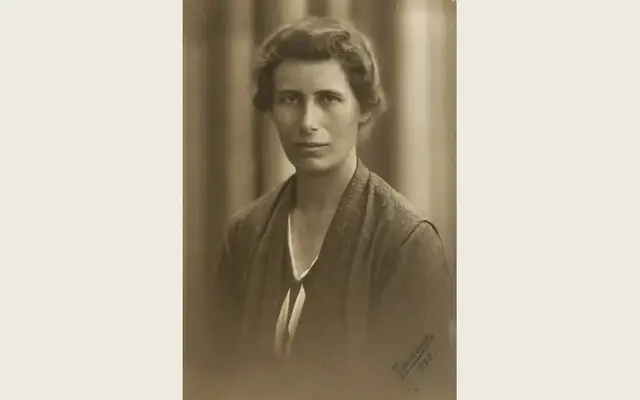
Her story is a reminder that scientific data do not arrive already divided into noise and discovery. That division depends on the questions asked and on confidence in what the instruments have measured. A faint arrival can be dismissed, misunderstood, or made central to a better model. Lehmann's achievement lay in the exacting scrutiny that allowed an apparent exception to become evidence of an unseen boundary. The accompanying 1932 portrait identifies the person behind the inference, but the most important image remains an imagined planet whose structure had to be reconstructed from waves recorded far above its hidden center.