A spectrum is not a simple ingredient list
Reading the chemical composition of a distant star presents a deceptively simple temptation. If one element produces especially conspicuous lines in a spectrum, perhaps there is simply more of that element in the star. Cecilia Payne's graduate work showed why that inference could be misleading. The appearance of a spectral line also depends on physical conditions and on the state of the atoms producing it. Her 1925 thesis, published as Stellar Atmospheres, connected an enormous observational archive with new atomic physics, changing the questions astronomers could ask about the material from which stars are made.
Payne arrived at Harvard College Observatory in 1923 after studying at Newnham College, Cambridge. The observatory offered access to photographic spectra and a community already engaged in classifying and comparing stars. Her doctorate was awarded through Radcliffe College, a distinction preserved in the foreword to the published monograph. These arrangements mattered to a woman entering advanced research at a time when academic opportunities were sharply unequal. The scientific problem was ambitious, but it was pursued through concrete institutional resources: plates, advisers, working space, a graduate program, and the means to publish a substantial investigation.
A new physical framework for old observations
The important physical framework included Meghnad Saha's work on ionization. Atoms can lose electrons, and the balance between different ionization states changes with temperature and pressure. A line associated with one state can therefore become weak even if the element itself is present in considerable quantity. Payne used this kind of reasoning to connect stellar spectra with the conditions in stellar atmospheres. The process involved calculation and comparison, not merely recognizing the laboratory signature of an element. It opened a route from the visible pattern to a physical explanation of why the pattern took that form.
Her thesis also helped explain the sequence of spectral classes used by astronomers. Large differences in the appearance of stellar spectra need not imply equally large differences in their overall chemical makeup. Temperature could account for much of the variation. This was a powerful relationship between classification and explanation. Observers had assembled a usable ordering of stars; physical theory made it possible to understand what that ordering represented. Payne's contribution depended on both sides of that relationship. Atomic calculations without reliable observations, or observations without an appropriate model, would not have produced the same result.
An extraordinary result with a printed reservation
The abundance calculations led to an especially unexpected implication: hydrogen and helium were extraordinarily abundant in stellar atmospheres. That conclusion conflicted with expectations shaped by the composition of familiar terrestrial material. The published thesis contains reservations about the enormous values obtained for those elements. Reading the book itself preserves a feature that can disappear in a short celebration of discovery: an important calculation and a cautious interpretation can coexist on the same page. The scientific achievement was not made less significant by that tension, but its historical presentation becomes more accurate when the reservation is acknowledged.
Institutional accounts describe expert skepticism, including the response of Henry Norris Russell, as part of the circumstances surrounding the thesis. A history of the episode need not invent a private confrontation or put dramatic words into anyone's mouth. The available record already shows the difficulty of evaluating a result that challenges an established picture. A surprising numerical answer requires checking, but established expectations can also impede recognition of what the answer means. The subsequent acceptance of hydrogen's dominance should not be projected backward as though every participant in 1925 already possessed the later consensus.
A scientific career beyond the famous thesis
Payne continued far beyond the work for which she is best known. Her research included variable stars, much of it conducted with Sergei Gaposchkin, whom she married in 1934. She taught, advised, and investigated while her formal status remained restricted. In 1956 she became a full professor and chair of Harvard's astronomy department. The long interval between the thesis and that appointment reveals the difference between intellectual achievement and institutional advancement. Neither the later position nor the recognition attached to it should eclipse the decades of scientific work that lay between the two events.
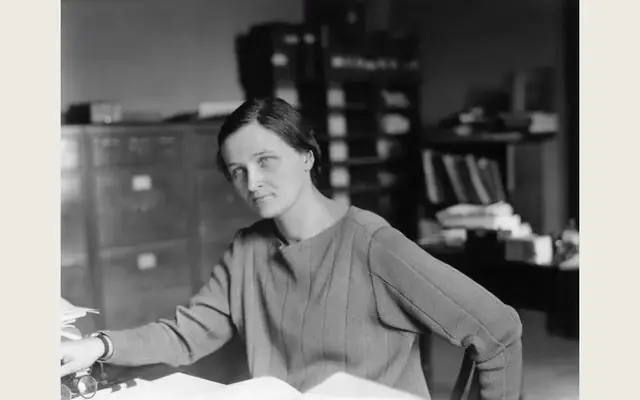
Stellar Atmospheres remains revealing because it allows readers to encounter research before its conclusions hardened into a textbook summary. Its foreword explicitly treats the field as developing and anticipates revision. The photograph accompanying this article identifies the astronomer, while the book preserves the much less photogenic work of reasoning through observations and assumptions. Payne's story is therefore about more than correctly naming the chief ingredient of stars. It is about learning how a signal is produced, and recognizing that what stands out most strongly to the eye is not always what exists in the greatest amount.