Patterns that had to become a structure
An X-ray diffraction pattern is not a ready-made picture of a molecule. Turning measured spots into an account of where atoms are arranged requires experiments, calculations, and interpretation. Dorothy Crowfoot Hodgkin made that difficult transformation central to a long scientific career. Her work on biologically important substances helped extend crystallography to increasingly complicated structures. The achievement is sometimes compressed into a list of famous molecules. Looking at the different projects and their timescales reveals something more informative: a research practice that grew through new apparatus, persistent analysis, and the contributions of students and collaborators over many years.
Born in Cairo in 1910, Hodgkin developed interests that crossed chemistry, crystals, and archaeology. Her biographical account describes time spent with her parents at Jerash, drawing mosaic pavements before university. At Oxford, where she studied from 1928 to 1932, crystallography became a direction for research. Work with J. D. Bernal at Cambridge then connected that interest with substances of biological importance. These were specific stages in acquiring a technique and choosing problems, rather than evidence that the entire later career had been mapped out in advance. Training and encounters helped determine what became possible next.
Building a research practice at Oxford
She returned to Oxford in 1934 with support from Somerville College. Establishing a research practice required more than an interesting scientific question. Equipment had to be obtained, funding collected, and rooms made usable. The Nobel biographical account describes a group that expanded gradually from a small number of students and visitors. Much of the work took place in spaces associated with the university museum. These practical details make the eventual molecular structures less mysterious. An apparently elegant final model rested on an extended material infrastructure that rarely appears when a discovery is remembered only through its finished result.
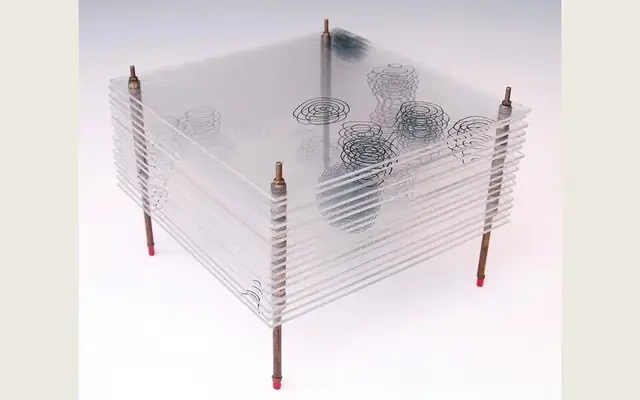
Crystals made the experiments possible because their ordered arrangement produced patterns that could be measured and analyzed. Those patterns constrained proposed structures, but interpreting them was not equivalent to simply magnifying a specimen. Researchers had to relate experimental data to a three-dimensional arrangement. The photograph accompanying this article shows a model associated with the determination of penicillin's structure, dating to around 1945. Its contour lines represent electron density. It is a physical aid to understanding the results, not an enlarged photograph of an individual molecule, and its appearance preserves something of the work of visualizing a difficult spatial problem.
Several molecules and several timescales
The Oxford group began investigating penicillin during the Second World War. Determining its structure became an important part of understanding a substance of exceptional medical significance. Hodgkin's work established the structure in 1945. Vitamin B12 presented another major challenge, with her research on it beginning in 1948. The problems differed in scale and complexity, even though both drew on X-ray techniques. Describing them as a single breakthrough hides the accumulation of experimental and interpretive work. A method becomes powerful not only when it succeeds once, but when researchers learn how to adapt it to a more demanding case.
Insulin belonged to a still longer timescale. Hodgkin had been interested in it early in her Oxford career, but its structure took decades to resolve. The Royal Society account dates that result to 1969. This chronology matters because her Nobel Prize in Chemistry had already been awarded in 1964. It would be misleading to describe the completed insulin structure as the result for which that earlier prize was given. The award recognized work on important biochemical substances, while research continued afterward. A major honor marks an assessment at a particular moment, not the completion of every project associated with its recipient.
Recognition without an ending to the work
Rheumatoid arthritis introduced additional practical difficulties. The Royal Society records changes to equipment, including an adapted switch, that allowed her to continue experiments when painful hands made ordinary operation difficult. Such details belong to the working history of science rather than to a separate inspirational anecdote. They show how an investigator's access to a technique can depend on the design of the apparatus as well as on intellectual skill. Her group also depended on other people. The penicillin model's museum documentation credits several contributors, reminding viewers that a celebrated scientific name does not imply a project performed entirely alone.
Hodgkin's career demonstrates why the history of a structure is larger than its final diagram. Experimental opportunities, money, teaching, calculation, collaboration, and physical adaptation all contributed to what could be established. The resulting models helped make complex biochemical substances intelligible in new ways. They also preserve the limits of a familiar discovery narrative. Neither a portrait of a Nobel laureate nor a single molecular drawing can show the years during which results were uncertain and methods were being made to work. Following those years gives the achievement its proper scale and makes the finished structure more, rather than less, impressive.