A writer known through a courtly name
Some historical writing records campaigns, rulers, and the formal sequence of public events. The Pillow Book attracts attention through a different scale of observation. Sei Shōnagon writes about appearances, moments, preferences, and the pleasures and irritations of courtly life. A list or brief recollection can carry as much literary force as a continuous narrative. The resulting work has outlasted the particular social world that made its judgments immediately intelligible. Its survival invites modern readers to take small details seriously while recognizing that the voice selecting them belongs to a specific place within a highly unequal society.
Sei Shōnagon served Empress Teishi, also known as Sadako, at the Japanese imperial court in the late tenth century. Her familiar name combines a form associated with her family name and a court title; it is not a straightforward modern personal name. Much about her life outside court service remains uncertain. The absence of a complete biography is worth preserving rather than filling with later legends. Her work gives access to a literary voice and a represented social setting, but it cannot be made to answer every question about the ordinary life of the person who produced it.
Why small observations deserve attention
The book's mixture of forms helps explain its continuing appeal. Lists organize perceptions by association rather than by a single chronology. Anecdotes and descriptions can turn a brief social exchange into an occasion for judgment. The reader moves between different kinds of attention instead of following one uninterrupted plot. Calling the work a diary can be helpful only if the limits of that label remain clear. It is not simply a set of dated entries preserving every day in order, and its literary effect depends on selection, arrangement, and the differences between its individual pieces.
The manuscript tradition complicates the idea of one fixed original sequence. Surviving versions were copied long after the author's lifetime and differ in their arrangement. A modern edition's order therefore should not be treated automatically as a recovered schedule of composition. The distinction is especially important for a work made from shorter sections. Rearranging such sections can change the rhythm of a reading experience without creating an entirely different set of observations. Transmission affects not just whether words survive, but how a later reader encounters their connections and contrasts across the larger work.
Elegance with a clearly situated perspective
The represented court is a world in which clothing, verbal skill, ceremonial knowledge, and sensitivity to setting can become forms of distinction. Sei Shōnagon's attention to them is evidence of values, not merely a decorative catalogue of beautiful things. A seemingly small mistake can matter because it reveals whether someone knows how to behave within the circle she describes. This is one reason the book rewards historical reading. Its preferences disclose rules that may be unstated precisely because the intended or imagined audience already understood their force. Modern readers have to reconstruct those assumptions rather than assume them to be universal.
That reconstruction also requires noticing exclusions. The wit and aesthetic precision that attract readers do not make the author a spokesperson for everyone in Heian Japan. Her judgments can be harsh toward people outside the privileged world she valued. Admiration for literary skill need not require agreement with those judgments. A situated perspective is valuable evidence when it is recognized as such. The book can illuminate the attitudes of a courtly circle while leaving many other lives largely outside its frame, and its selectivity is itself part of the social history that a careful reading can reveal.
A text and an image transmitted across centuries
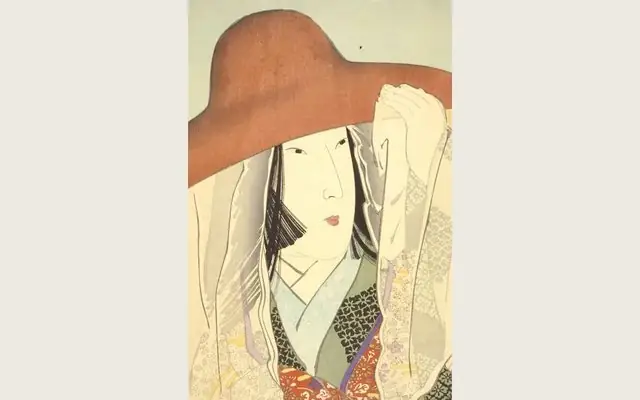
Sei Shōnagon also became a subject for much later artists. The accompanying image is one panel from Kobayashi Kiyochika's 1896 woodblock triptych, held by the Los Angeles County Museum of Art. It is a later representation, not a contemporary likeness of a woman who lived around the year 1000. Museum collections preserve other later images as well, including a nineteenth-century print by Utagawa Kunisada in Houston. Such works show an author continuing to occupy the cultural imagination. They document reception across centuries rather than supplying visual confirmation of exactly what she looked like during court service.
The Pillow Book's endurance comes partly from the way its particulars remain open to attention. Readers can recognize the energy of noticing without pretending that the social setting is their own. Its history also asks them to distinguish the author from later legends, the transmitted text from an imagined autograph, and a historical world from the selection of it presented by one voice. Those distinctions do not drain the pleasure from the writing. They make room for a more alert encounter with a book in which a passing observation can preserve both a moment of beauty and the assumptions of the person who chose to remember it.