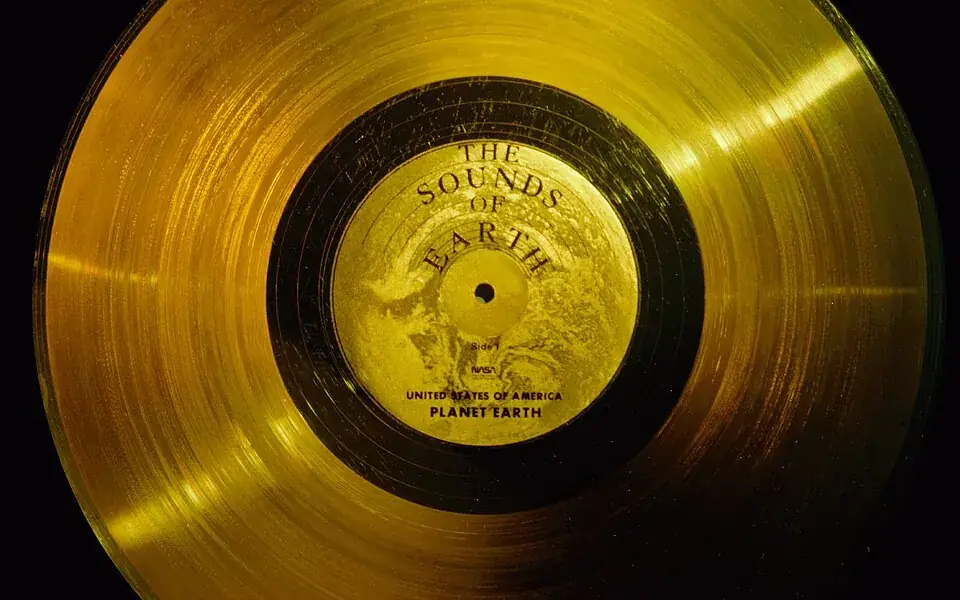
Each of the two Voyager probes launched in 1977 carried a gold-plated copper record containing images, music, natural sounds, and greetings in many languages.
The records were collections of messages for any extraterrestrial discoverers and included playback instructions. Their selections sought to represent the diversity of Earth's life and human cultures.
Background
The Voyager 1 probe is currently the farthest human-made object from Earth. Both Voyager 1 and Voyager 2 have reached interstellar space, the region between stars where the galactic plasma is present. Like their predecessors Pioneer 10 and 11, which featured a simple plaque (the idea of Eric Burgess and Carl Sagan), both Voyager 1 and Voyager 2 were launched by NASA with a message aboard—a kind of time capsule, intended to communicate to extraterrestrials a story of the world of humans on Earth.
While the Pioneer plaques established the precedent, the idea for including information on humanity onboard the Voyagers was the brainchild of John R. Casani, the project manager. He delegated the task to Sagan, who with colleagues Linda Salzman and Frank Drake realized a metal phonograph record with visual information (encoded into grooves by a company in Boulder, Colorado) would outlast magnetic tapes in the outer space environment. The budget Casani gave Sagan was $1,500 for six weeks of work (though Sagan and his colleagues contributed more money out of pocket); he stipulated the Record had to be as light as the Pioneer plaque.
Contents
The contents of the record were selected for NASA by a committee chaired by Carl Sagan of Cornell University. The selection of content for the record took almost a year. Sagan and his associates assembled 116 images (one used for calibration) and a variety of natural sounds, such as those made by surf, wind, thunder and animals (including the songs of birds and whales). To this they added audio content to represent humanity: spoken greetings in 55 ancient and modern languages, including a spoken greeting in English by U.N. Secretary-General Kurt Waldheim and a greeting by Sagan's six-year-old son Nick; other human sounds, like footsteps and laughter (Sagan's); the inspirational message Per aspera ad astra in Morse code; and musical selections from different cultures and eras. The record also includes a printed message from U.S. president Jimmy Carter.
The collection of images includes many photographs and diagrams, both in black and white and color. The first images are of scientific interest, showing mathematical and physical quantities, the Solar System and its planets, DNA, and human anatomy and reproduction. Care was taken to include not only pictures of humanity, but also some of animals, insects, plants and landscapes. Images of humanity depict a broad range of cultures. These images show food, architecture, and humans in portraits as well as going about their day-to-day lives. Many pictures are annotated with one or more indications of scales of time, size, or mass. Some images contain indications of chemical composition. All measures used on the pictures are defined in the first few images using physical constants that are the same across the universe.
Manufacturing
Blank records were provided by the Pyral S.A. of Créteil, France. CBS Records contracted the JVC Cutting Center in Boulder, Colorado to cut the lacquer masters that were then sent to the James G. Lee record-processing center in Gardena, California to cut and gold-plate eight Voyager records. After the records were plated they were mounted in aluminum containers and delivered to JPL.
The record is a copper disk 12 inches (30 cm) in diameter plated first with nickel and then gold. The record's cover is aluminum and electroplated upon it is an ultra-pure sample of the isotope uranium-238. Uranium-238 has a half-life of 4.468 billion years. It is possible (e.g., via mass spectrometry) that a civilization that encounters the record will be able to use the ratio of remaining uranium to the other elements to determine the age of the record.