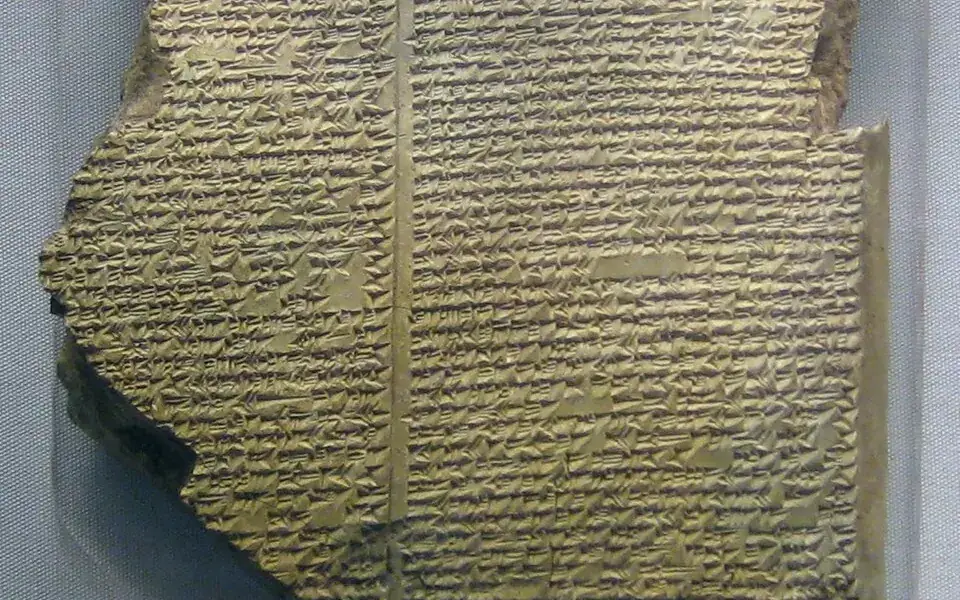
The Epic of Gilgamesh comes from Mesopotamia's literary traditions. It tells of a king and Enkidu while exploring friendship, death, and the search for immortality.
The text survives in tablet versions from different periods, and modern editions assemble fragments. It was not passed down directly from one complete original manuscript.
Discovery
About 15,000 fragments of Assyrian cuneiform tablets were discovered in the Library of Ashurbanipal in Nineveh by Austen Henry Layard, his assistant Hormuzd Rassam, and W. K. Loftus in the early 1850s. Late in the following decade, the British Museum hired George Smith to study them. In 1872, Smith read translated fragments before the Society of Biblical Archaeology, and in 1875 and 1876 he published fuller translations, the latter of which was published as The Chaldaean Account of Genesis. The central character of Gilgamesh was initially reintroduced to the world as "Izdubar", before the cuneiform logographs in his name could be pronounced accurately. In 1891, Paul Haupt collected the cuneiform text, and nine years later, orientalist Peter Jensen provided a comprehensive edition; R. Campbell Thompson updated both of their work in 1930. Over the next two decades, Samuel Noah Kramer reassembled the Sumerian poems.
In 1998, American Assyriologist Theodore Kwasman discovered a piece believed to have contained the first lines of the epic in the storeroom of the British Museum. The fragment, found in 1878 and dated to between 600 BCE and 100 BCE, had remained unexamined by experts for more than a century since its recovery. The fragment read "He who saw all, who was the foundation of the land, who knew (everything), was wise in all matters: Gilgamesh." The discovery of artifacts (c. 2600 BCE) associated with Enmebaragesi of Kish, mentioned in the legends as the father of one of Gilgamesh's adversaries, has lent credibility to the historical existence of Gilgamesh.
Versions
Distinct sources exist from over a 2,000-year timeframe. The earliest Sumerian poems are now generally considered to be distinct stories, rather than parts of a single epic. Some of these may date back to as early as the Third Dynasty of Ur (c. 2100 BCE). The Old Babylonian tablets (c. 1800 BCE) are the earliest surviving tablets for a single Epic of Gilgamesh narrative. The older Old Babylonian tablets and later Akkadian version are important sources for modern translations, with the earlier texts mainly used to fill in gaps (lacunae) in the later texts. Although several revised versions based on new discoveries have been published, the epic remains incomplete. Analysis of the Old Babylonian text has been used to reconstruct possible earlier forms of the epic.
The most recent Akkadian version, also referred to as the Standard Babylonian version, consists of twelve tablets and was edited by Sîn-lēqi-unninni, who is thought to have lived sometime between 1300 BCE and 1000 BCE.
From the diverse sources found, two main versions of the epic have been partially reconstructed: the Standard Babylonian version, or He who saw the deep, and the Old Babylonian version, or Surpassing all other kings. Five earlier Sumerian poems about Gilgamesh have been partially recovered, some with primitive versions of specific episodes in the Babylonian version, others with unrelated stories.
Standard Babylonian version
The Standard Babylonian version was discovered by Hormuzd Rassam in the library of Ashurbanipal in Nineveh in 1853. "Standard Babylonian" refers to a literary style that was used for literary purposes. This version was compiled by Sin-leqi-unninni sometime between 1300 and 1000 BCE from earlier texts. One impact that Sin-leqi-unninni brought to the work was to bring the issue of mortality to the foreground, thus making it possible for the character to move from being an "adventurer to a wise man." The Brazilian scholar Lins Brandão saw the standard version can be seen in this sense as "sapiential literature," ("wisdom literature"), which is common in the Middle East, but this idea has not been widely accepted.