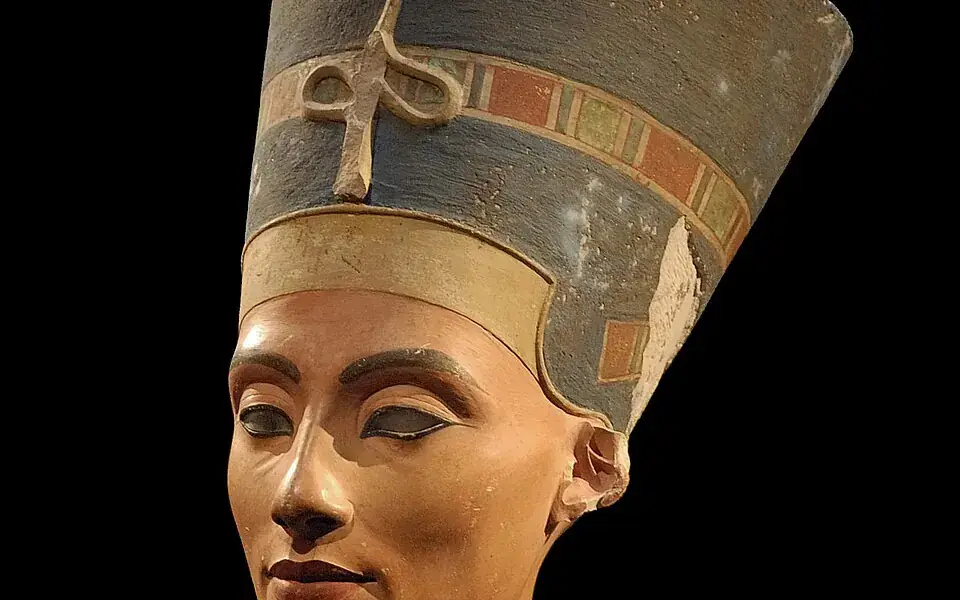
The Nefertiti Bust is an ancient Egyptian painted sculpture discovered in the Amarna region in the early 20th century. It is famous for its depiction of the queen's face and tall crown.
The work combines a stone core with modeled and colored surfaces. It has also prompted debates about ownership, and its journey forms part of modern museum history.
Background
Nefertiti (meaning "the beautiful one has come forth") was the 14th-century BC Great Royal Wife (chief consort) of the Egyptian Pharaoh Akhenaten of the Eighteenth Dynasty of Egypt. Akhenaten initiated a new monotheistic form of worship called Atenism dedicated to the Sun disc Aten. Little is known about Nefertiti. Theories suggest she could have been an Egyptian royal by birth, a foreign princess or the daughter of a high government official named Ay, who became pharaoh after Tutankhamun. She may have been the co-regent of Egypt with Akhenaten, who ruled from 1352 BC to 1336 BC. Nefertiti bore six daughters to Akhenaten, one of whom, Ankhesenpaaten (renamed Ankhesenamun after the suppression of the Aten cult), married Tutankhamun, Nefertiti's stepson.
While it was once thought that Nefertiti disappeared in the twelfth year of Akhenaten's reign because of her death or because she took a new name, she was still alive in the sixteenth year of her husband's reign according to a limestone quarry inscription found at Deir Abu Hinnis "on the eastern side of the Nile, about ten kilometres north of Amarna", in today's Al-Minya Governorate. Nefertiti may have become a pharaoh in her own right for a short time after her husband's death.
Discovery and removal from Egypt
The bust was found on 6 December 1912 at Amarna by an archaeological team funded by the German Oriental Society (Deutsche Orient-Gesellschaft – DOG), a voluntary association founded by one of the wealthiest men in Prussia, James Simon, who exported more than 20,000 artefacts from Egypt and Iraq. The team was led by German archaeologist Ludwig Borchardt. The bust was found in what had been the workshop of the sculptor Thutmose, along with other unfinished busts of Nefertiti. Borchardt's diary provides the main written account of the find; he remarks, "Suddenly we had in our hands the most alive Egyptian artwork. You cannot describe it with words. You must see it."
A 1924 document found in the archives of the German Oriental Society recalls a 20 January 1913 meeting between Borchardt and a senior Egyptian official to discuss the division of the archeological finds of 1912 between Germany and Egypt. According to the secretary of the German Oriental Society (who was the author of the document and who was present at the meeting), Borchardt "wanted to save the bust for us", referring to Germany.
While Philipp Vandenberg describes the acquisition as "adventurous and beyond comparison", Time magazine lists it among the "Top 10 Plundered Artifacts". Borchardt showed Egypt's French chief antiques inspector, Gustave Lefebvre, a photograph of the bust "that didn't show Nefertiti in her best light". When Lefebre inspected the artifacts found in the investigation, the bust was already wrapped up in a box sitting in a dimly lit room. It is unknown whether Lefebre "went to the trouble of lifting the bust out of the box". Borchardt also wrongly claimed the bust was made of gypsum, instead of limestone. The German Oriental Society maintains that the finds of the dig were divided fairly, noting that Nefertiti was at the top of the exchange list and that "the inspector could have looked at everything closely at the time".
Description and examinations
The bust is 48 centimetres (19 in) tall and weighs about 20 kilograms (44 lb). It is made of a limestone core covered with painted stucco layers. The face is completely symmetrical and almost intact, but the left eye lacks the inlay present in the right. The iris of the right eye is of inserted quartz with black paint and is fixed with beeswax. The background of the eye-socket is unadorned limestone. Nefertiti wears her characteristic blue crown known as the "Nefertiti cap crown" with a golden diadem band looped around like horizontal ribbons and joining at the back, and an Uraeus (cobra), which is now broken, over her brow. She also wears a broad collar with a floral pattern. The ears have suffered some damage.
Gardner's Art Through the Ages suggests that "With this elegant bust, Thutmose may have been alluding to a heavy flower on its slender sleek stalk by exaggerating the weight of the crowned head and the length of the almost serpentine neck."