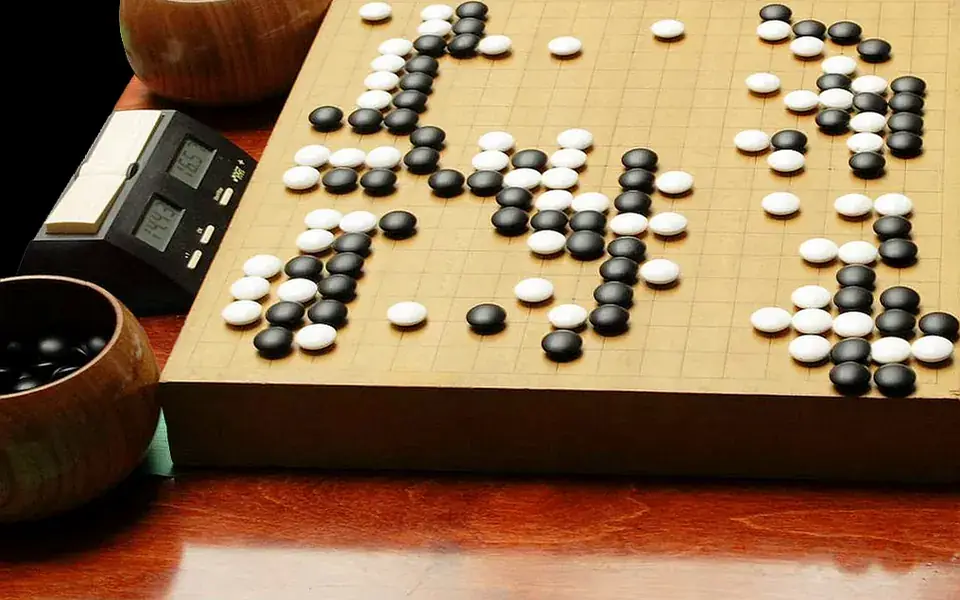
In Go, players place black and white stones at intersections, competing to surround territory and capture stones. The basic rules for placing stones are fairly simple, yet positions produce enormous numbers of combinations.
Go has a long history in East Asia, where different regions developed game records, ranks, and tournaments. Different scoring systems also remain in modern use.
Origin in China
The earliest written reference to the game is generally recognized as the historical annal Zuo Zhuan (c. 4th century BCE), referring to a historical event of 548 BCE. It is also mentioned in Book XVII of the Analects of Confucius and in two books written by Mencius (c. 3rd century BCE). In all of these works, the game is referred to as yì. Today, in China, it is known as weiqi, lit. 'encirclement board game'.
Go was originally played on a 17×17 line grid, but a 19×19 grid became standard by the time of the Tang dynasty (618–907 CE). Legends trace the origin of the game to the mythical Chinese emperor Yao (2337–2258 BCE), who was said to have had his counselor Shun design it for his unruly son, Danzhu, to favorably influence him. Other theories suggest that the game was derived from Chinese tribal warlords and generals, who used pieces of stone to map out attacking positions.
In China, Go had an important status among elites and was associated with ideas of self-cultivation, wisdom, and gentlemanly ideals. It was considered one of the four cultivated arts of the Chinese scholar gentleman, along with calligraphy, painting and playing the musical instrument guqin. In ancient times the rules of Go were passed on verbally, rather than being written down.
Spread to Korea and Japan
Go was introduced to Korea sometime between the 5th and 7th centuries CE, and was popular among the higher classes. In Korea, the game is called baduk, and a variant of the game called Sunjang baduk was developed by the 16th century. Sunjang baduk became the main variant played in Korea until the end of the 19th century, when the current version was reintroduced from Japan.
The game reached Japan in the 7th century CE—where it is called go or igo. It became popular at the Japanese imperial court in the 8th century, and among the general public by the 13th century. The game was further formalized in the 15th century. In 1603, Tokugawa Ieyasu re-established Japan's unified national government. In the same year, he assigned the then-best player in Japan, a Buddhist monk named Nikkai (né Kanō Yosaburo, 1559), to the post of Godokoro (Minister of Go).
Nikkai took the name Hon'inbō Sansa and founded the Hon'inbō Go school. Several competing schools were founded soon after. These officially recognized and subsidized Go schools greatly developed the level of play and introduced the dan/kyu style system of ranking players. Players from the four schools (Hon'inbō, Yasui, Inoue and Hayashi) competed in the annual castle games, played in the presence of the shōgun.
Basic rules
The two players, Black and White, take turns placing stones of their color on the intersections of the board, one stone at a time. The usual board size is a 19×19 grid, but for beginners or for playing quick games, the smaller board sizes of 13×13 and 9×9 are also popular. The board is empty to begin with. Black plays first unless given a handicap of two or more stones, in which case White plays first. The players may choose any unoccupied intersection to play on except for those forbidden by the ko and suicide rules . Once played, a stone can never be moved and can be taken off the board only if it is captured.
A player may pass their turn, declining to place a stone, though this is usually only done at the end of the game when both players believe nothing more can be accomplished with further play. When both players pass consecutively, the game ends and is then scored.