An experience and the time spent interpreting it
A book can begin with an event without being written all at once. Julian of Norwich's account of revelations experienced during a serious illness in 1373 offers a striking example. What survives is the result of reflection, revision, and transmission, not simply a record made at the instant of an experience. Her work is widely recognized as the earliest surviving book in English known to have been written by a woman. That description concerns the evidence that has reached us. It should not be taken to mean that no earlier woman ever composed a book in the language.
Julian lived in medieval Norwich and became an anchoress associated with St Julian's Church. This form of religious life involved enclosure in a cell, but it should not encourage the assumption that writing there had no relationship with a wider community. Her text is directed toward readers and toward the interpretation of Christian belief. Much of her ordinary biography remains unknown. The name by which she is remembered, the surviving work, and references to her religious setting do not provide a complete record of childhood, household, or every stage of education and composition.
Two texts with different histories
The text exists in two substantially different forms, usually called the Short Text and the Long Text. They should not be imagined merely as a complete book and a modern abridgment of it. The British Library's catalogue describes the Short Text as an earlier account that may have been written in the 1380s. It places the expansion into the Long Text in or after 1393, while other institutional summaries describe a longer version around that date. The differing formulations are a reason to avoid supplying an exact year for every stage of a process that the evidence does not date so neatly.
That long process of reconsideration is central to the achievement. The revelations became the basis for an extended exploration of suffering, love, prayer, and the relationship between human frailty and divine care. The work moves between the account of what Julian experienced and the effort to understand it. An event is therefore not the same as its later explanation. Reading with that distinction in mind allows the book to appear as sustained intellectual labor rather than merely as a sudden message whose meaning arrived complete and required no further work from the person who recorded it.
How later copyists carried the work forward
The surviving manuscripts introduce another important distinction. A book attributed to a medieval author does not necessarily survive in that author's own handwriting. The British Library records Sloane MS 3705 as an eighteenth-century copy of the Long Text. Its account places the earliest complete surviving copies within the early modern transmission associated with English religious women in northern France. These facts connect the medieval composition to communities of later readers and copyists. Preserving a text required deliberate action across generations, and the material evidence for that action belongs to a different period from the experience described within the book.
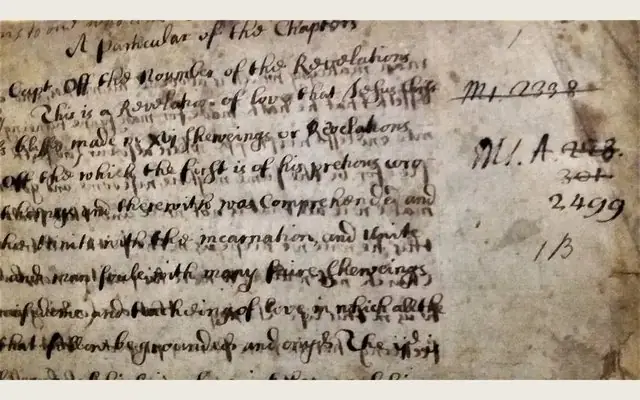
The photograph accompanying this article shows an opening contents list in Sloane MS 2499, another later witness to the Long Text. It is not Julian's original notebook from 1373. The difference matters when an old-looking page is used to illustrate an author's life. A manuscript can preserve medieval words while being a much later physical object. Its handwriting, paper, and copying history tell one story; the composition transmitted through it tells another. Keeping both stories visible makes the survival of the work more remarkable rather than diminishing its connection with the medieval past.
A medieval author read through modern editions
Printed editions and translations of older English create further stages of encounter. Grace Warrack's 1901 edition, now available through Project Gutenberg, includes editorial discussion as well as the text. Its account of manuscripts reflects the information and assumptions available to an editor of that time. It should therefore be read beside current catalogue descriptions rather than treated as a final guide to every surviving witness. The edition also demonstrates how modern presentation can introduce a work to new readers while adding a layer of explanatory language, organization, and historical interpretation around the older writing.
Julian's book has endured through more than the memorability of a few familiar phrases. It survives because the writing rewards sustained attention, and because later communities continued to copy, preserve, edit, and read it. The history of that survival brings together a medieval religious life and the practical work of transmission. Neither can replace the other. An account of an experience becomes a major historical text through acts of interpretation, while later manuscripts keep those acts available to readers who live in very different circumstances. That is a richer story than imagining a single finished volume appearing fully formed in a medieval cell.