A historian introduces herself
At the beginning of the Alexiad, Anna Komnene introduces both a subject and a problem. She intends to preserve the deeds of her father, the Byzantine emperor Alexios I Komnenos. Yet writing about a parent exposes her to the accusation that family loyalty will overwhelm historical judgment. She addresses that difficulty directly. The resulting work is not an accidental storehouse of facts left behind by someone near the court. It is a deliberately shaped history, written by an author who understood that her relationship with the central figure would influence the way readers assessed her authority.
Alexios ruled from 1081 to 1118. Anna wrote her substantial account in the middle of the twelfth century, after the reign she described. That interval makes the book retrospective rather than a daily chronicle recorded as events unfolded. The difference does not make it worthless as evidence. It makes the conditions of composition important. Memory, available testimony, written materials, and the purpose of the finished narrative all enter the discussion. The text preserves a perspective from within an imperial family while also belonging to the later intellectual setting in which that perspective was organized into a book.
Family proximity as evidence and difficulty
In her preface, Anna emphasizes her education and familiarity with Greek learning. She presents those qualifications alongside an awareness of the expectations surrounding her position. The Alexiad's language is deliberately classical, connecting its historical subject to prestigious literary traditions. Such choices are not decorative additions that can simply be peeled away to reveal an untouched factual core. They help produce the authority of the narrator and the stature of the emperor. A reader who notices the rhetoric can ask more precise questions about what a passage is trying to accomplish as well as about the event it describes.
Family proximity offered access but also posed a challenge. Anna's account repeatedly directs attention toward the judgment, endurance, and ingenuity of her father. Her stated ambition to exercise fairness therefore exists beside a strong pattern of admiration. Both features belong to the work. Modern historians do not have to choose between accepting her claims without qualification and dismissing everything as praise. They can compare passages, examine the selection of detail, and set the narrative beside other evidence. A partial perspective remains historically informative when its position is acknowledged rather than mistaken for a view from nowhere.
An artfully arranged account of power
The Alexiad unfolds in fifteen books, covering conflicts, diplomacy, internal politics, religious disputes, and the emperor's final illness. The narrative gives substantial attention to western opponents and to encounters connected with the First Crusade. Coverage is uneven across the reign. Some episodes occupy far more space than others, and literary arrangement does not always follow a strict chronological sequence. That organization is part of the author's argument. The amount of attention given to an event can tell us about the shape of the finished history without directly measuring the event's importance to everyone who lived through the period.
Leonora Neville's scholarship draws particular attention to Anna's construction of an authoritative female historical voice. Her accessible book abstract also challenges familiar accounts that define Anna chiefly through an alleged struggle for political power. The lesson is methodological rather than a license to replace one confident story with another. Later scholars can inherit assumptions that deserve to be reopened. Distinguishing contemporary evidence, later interpretation, and the author's own self-presentation allows the Alexiad to be approached as an ambitious intellectual work instead of merely as a symptom of a supposedly frustrated personal ambition.
Reading a major source with its perspective intact
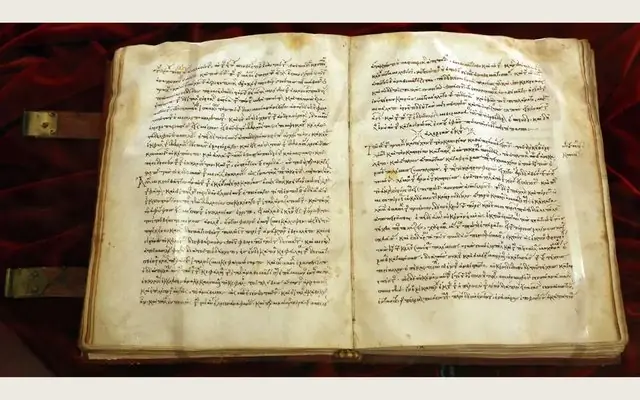
The surviving manuscript tradition adds another layer between composition and a modern reader. The accompanying photograph shows a manuscript of the Alexiad identified as a twelfth-century example in Florence's Biblioteca Medicea Laurenziana, not a portrait of Anna. It offers evidence of the work's material transmission rather than a glimpse of the author holding her pen. Translations introduce further decisions about names, style, and vocabulary. Elizabeth Dawes's English version, available through Fordham's sourcebook, makes the text accessible while remaining a particular translation with its own editorial history and choices about how to convey Anna's language.
The Alexiad matters because a powerful account of the past can be both indispensable and interested. Its perspective helps explain its vividness, its distribution of sympathy, and its literary ambition. Reading critically does not require pretending that an author should have had no commitments. It requires understanding what those commitments do within a text. Anna's work rewards that attention by revealing not only the reign she sought to commemorate but also the effort involved in claiming historical authority. A daughter defending her father and a historian shaping an argument can inhabit the same pages without becoming the same question.