A name inside an ancient literary tradition
Among the many names preserved from ancient Mesopotamia, Enheduanna has an unusual connection with the history of writing. She was a high priestess at Ur and a daughter of Sargon of Akkad, living in the third millennium BC. Literary works transmitted under her name bring an identifiable female voice into a tradition often encountered through anonymous compositions. Yet the attraction of calling her an early named author should not flatten the evidence. A historical person, a speaker within a poem, and the surviving copies of that poem belong to connected but distinguishable histories.
Hallo and van Dijk's scholarly study of The Exaltation of Inanna brings together archaeological, inscriptional, and literary material. It identifies Enheduanna's priestly position in the service of the moon god Nanna at Ur. That office placed her within institutions where religious authority and royal power intersected. It should not be imagined as the occupation of a modern writer working privately for a commercial publisher. The setting of her name was a world of temples, inherited ritual practice, and political relationships, in which language could participate in the exercise and representation of authority.
What a surviving object can establish
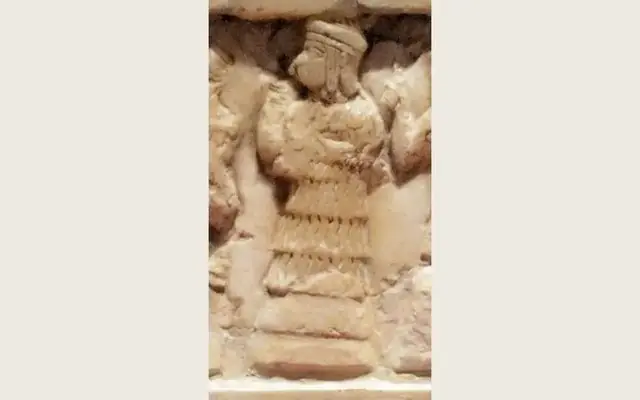
The disk associated with Enheduanna gives the discussion a material anchor. The object, held at the Penn Museum, combines a relief scene with an inscription identifying her. Its significance is different from that of a tablet containing a literary composition. It helps establish a person and an office in a contemporary historical setting, but does not demonstrate that every surviving poem attributed to her was written in its present form during her lifetime. The photograph accompanying this article shows a detail of the priestess on the disk, not a modern likeness invented to illustrate the poetry.
This distinction also changes the way one looks at the relief. The represented priestess participates in a formal scene rather than appearing in the solitary pose of a later author portrait. Image and inscription communicate position and action through the conventions of their own culture. A viewer need not turn that scene into an invented moment of literary composition for it to matter to literary history. The disk establishes a presence in the historical record, while the texts raise a further question about how that presence came to carry authority in the transmission of particular compositions.
A poetic speaker addressing the divine
The Exaltation of Inana includes a first-person speaker who names herself as En-hedu-ana. In the Oxford translation, the speaker describes religious service, displacement, distress, and an appeal to a powerful goddess. These passages give the composition a personal dimension, but the voice remains part of a shaped poetic work. Repetition, divine praise, lament, and the movement toward resolution organize the material. Reading it as literature allows those features to remain visible instead of treating the poem as a transparent administrative report of an event whose every detail can be accepted without interpretation.
The Temple Hymns offers another form of association between a name and a text. Near its conclusion, the Oxford translation identifies En-hedu-ana as the compiler of the tablets. That attribution is important evidence for the literary tradition. It does not mean the modern reader is looking at a surviving autograph or at an unchanged original manuscript. The ancient works are reconstructed through witnesses copied and transmitted over time. Differences between those witnesses, and the scholarly decisions required to present a continuous text, belong to the history of how the compositions become readable again.
Authorship across a long history of copying
The gap between a historical lifetime and later manuscript evidence has generated debate about authorship and attribution. It is possible to acknowledge Enheduanna's importance without claiming that every question has been settled. Her name has a demonstrable place within the surviving tradition, while the precise relationship between that tradition and an original act of composition requires argument. The most useful account therefore explains what each category of evidence supports. A name in a poem, an inscription on an object, and a later scholarly reconstruction reinforce one another in some respects without becoming interchangeable proofs.
Enheduanna's story ultimately broadens the question of what it means for an author to survive. Survival can depend on repeated copying, religious institutions, teaching, and the willingness of later readers to preserve a voice. It can also depend on archaeologists and editors reconnecting dispersed evidence thousands of years afterward. The result is more compelling than a simple competition to identify a first. It reveals how a woman's name became attached to literary authority in an ancient culture, and how that association can remain powerful even when the route from her lifetime to the texts we read is incomplete.