Timbers in a changing coastal landscape
The name Seahenge invites the imagination to place an ancient monument beside the open sea. The surviving timbers from Holme Beach in Norfolk require a more careful picture. Their present coastal setting is the product of a changing landscape, not a guarantee that their builders saw the same shoreline. Exposed in the late twentieth century, the timber circle offered an exceptional opportunity to study actual prehistoric wood. Many ancient timber structures survive only as marks in soil where posts once stood. Here, the posts themselves could carry information about growth, working, arrangement, and the date of construction.
Historic England describes a circle of fifty-five closely spaced oak posts surrounding an inverted central tree stump. The monument was recognized in 1998 and excavated in 1998 and 1999. Its familiar nickname distinguishes it from the formal archaeological label Holme I. The sea that helped expose the timbers also threatened them. Once buried material becomes visible, the processes that reveal it can continue to remove it. The discovery therefore raised a practical problem alongside the historical one: how to record and preserve fragile evidence in a setting where the window for fieldwork changes with tides and weather.
A prehistoric year inside the wood
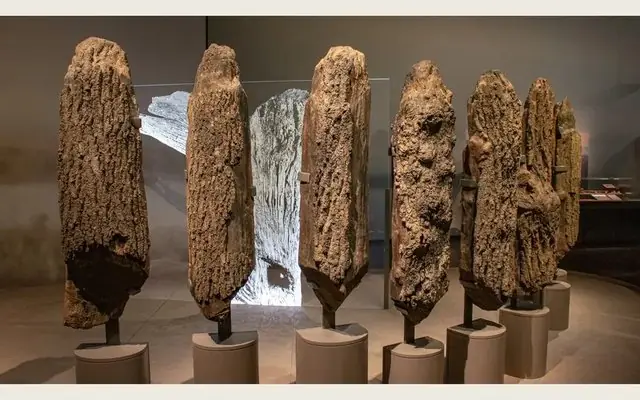
The timbers were removed for conservation during the 1999 work. This was not simply a matter of lifting strong new timber out of a building site. Archaeological wood that survives in wet conditions can deteriorate after exposure, requiring specialist handling and treatment. Removing the material protected it from continuing erosion, while also separating the original components from their coastal setting. The resulting museum presentation offers access to wood that would otherwise be vulnerable, but the visitor must still imagine the arrangement within a landscape different from the controlled conditions of a gallery.
Tree-ring dating gave the monument an unusually precise chronological anchor: oak used for construction was felled in 2049 BC. Dendrochronology compares sequences of wider and narrower annual rings with other sequences tied to calendar years. The result depends on the quality and extent of the surviving wood. Where the outer edge remains, the date of felling can be established much more closely than where outer rings have disappeared. It is therefore important to distinguish a dated tree from a broad estimate for an entire period, and a felling date from an explanation of a structure's purpose.
Why the second circle matters
Seahenge was not alone. A second timber circle, Holme II, lay roughly one hundred metres away. Ian Tyers's English Heritage report describes a more complicated arrangement, including an outer palisade, an inner arc, and central horizontal timbers associated with stakes and woven branches. It should not be treated as an identical duplicate of Holme I. Comparing related structures requires attention to their differences as well as their proximity. The discovery of another arrangement of wood also changes the scale of the question, suggesting that one famous circle belongs within a wider pattern of activity rather than an isolated spectacular act.
Sampling at Holme II in 2013 provided a significant connection. Wood from its outer circle and central setting was dated to the same felling year as the timber associated with Seahenge. The published 2014 analysis therefore established contemporaneity more securely than broad radiocarbon ranges alone could do. It did not establish that both monuments had exactly the same function or were used by precisely the same people. Shared dating can demonstrate a relationship in time while leaving relationships of authority, ceremony, and local organization open to further investigation through the structures and their surviving contexts.
Preserving evidence without pretending to know its purpose
The second circle also demonstrates the urgency of coastal recording. Norfolk's heritage service describes the loss and displacement of elements through erosion, including woven branches and central logs. Its technical investigation operated within constraints imposed by tides, wildlife protection, consent, and weather. Those practical conditions shape archaeological knowledge: an ideal research plan still has to work with the time available on a beach. The report records methods and limitations so that later readers can assess the conclusions. Such documentation is as important as a dramatic discovery photograph when evidence is changing or disappearing in the field.
The exact purposes of the Holme monuments remain uncertain. Their unusual arrangements invite interpretations involving ceremonial activity, but the wood cannot supply a complete script for what happened there. The photograph accompanying this article shows conserved Seahenge timbers displayed during the British Museum's World of Stonehenge exhibition, rather than posts still standing on the original beach. That distinction preserves the modern history of the image. The deeper achievement is that fragile wood can connect a precise prehistoric year with careful observation today, while reminding us how much of a landscape and its human meanings can remain beyond recovery.