A discovery first reported to the police
The discovery of Tollund Man began with a misunderstanding that was entirely reasonable. In May 1950, peat cutters encountered a human body in a bog near Silkeborg, Denmark. Its preservation made a recent death seem possible, and the police were notified. Archaeological investigation placed the remains in a very different timescale. The person had lived in the Iron Age. The encounter brought the distant past unusually close, but it also created an urgent modern problem: material preserved underground might change rapidly once removed from the conditions that had protected it.
Museum Silkeborg's account distinguishes the discovery from the report to the authorities. The body was found on 6 May, and the police received the message on 8 May. It lay in the Bjældskovdal bog, west of Silkeborg. The name Tollund came from the village associated with the finders, rather than from a surviving record of the man's own identity. That distinction matters. A modern label can make a person familiar while supplying no evidence of the name by which that person was known during life, or the community to which he understood himself to belong.
Evidence that cannot supply a complete biography
The preserved remains offered extraordinary physical information. Museum descriptions place the man at approximately forty years old and associate him with the early Iron Age, around the fourth century BC. His head retained recognizable facial features, while a cap, belt, and cord supplied evidence beyond bone alone. Researchers could study a particular human body rather than merely a generalized period. Nevertheless, measurements and material traces cannot reconstruct every experience of a life. They may reveal aspects of age, appearance, and treatment without recovering personal relationships, spoken language, or individual intentions in anything approaching the detail of a written biography.
The circumstances of death have consequently required cautious interpretation. Physical evidence supports death by hanging, but moving from the cause of death to its social meaning is a further step. Explanations involving ritual must be evaluated against the treatment of the body and wider archaeological comparisons. They should not be turned into a precisely narrated ceremony with invented participants and words. Tollund Man's strikingly recognizable appearance can encourage viewers to feel that they know him. The archaeological responsibility is to keep that emotional immediacy separate from claims about motives that the surviving evidence cannot securely establish.
The challenge of leaving the bog
Conservation presented a different set of questions. Water occupied spaces in the tissues, and simply allowing the remains to dry threatened deformation and loss. The National Museum undertook the preservation of the head through a sequence of treatments. Museum Silkeborg describes the replacement of bog water using alcohol, followed by other liquids that enabled the eventual introduction of wax. The method addressed a material problem rather than reversing the centuries underground. Its success depended on managing transitions between substances, making preservation an active and experimental intervention instead of a passive continuation of what the bog had already achieved.
The process lasted months, and the treated head emerged toward the end of 1951. Even the successful result involved change: the museum reports measurable shrinkage. Other parts of the body were not preserved in the same way and dried out. This uneven outcome is important when viewing photographs or the modern display. The body seen with the original head is a reconstruction of the appearance at discovery, rather than a claim that every visible surface is original human tissue. A museum can present a coherent impression while still explaining which elements survive and which were made later to aid understanding.
Seeing the original and the reconstruction together
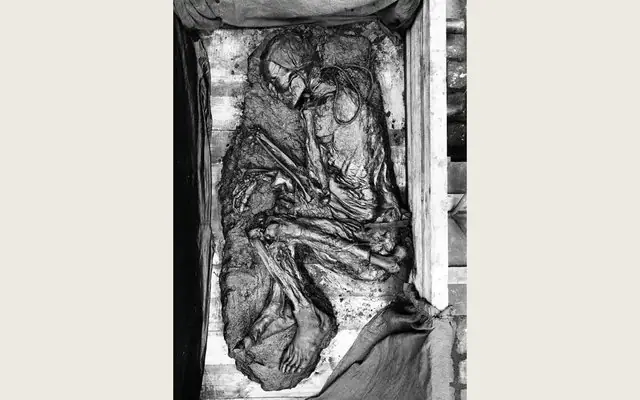
That explanation changes how the display should be read. Reconstruction may restore a sense of posture or scale that a preserved head alone would not convey. It also introduces modern decisions about materials and appearance. Visitors therefore benefit from treating a display as an interpretation built around evidence, not as an untouched archaeological scene. The National Museum photograph accompanying this article records the body in an archaeological handling context. It does not show the present reconstructed display, and should not be used to infer the current condition of all the remains. Different photographs preserve different moments in the history of the find.
Tollund Man's continuing significance rests on more than exceptional survival. The discovery exposes the distance between finding something, understanding it, and keeping it available for future study. Each stage introduces new techniques and limits. Scientific examinations may refine earlier conclusions, while conservation records explain changes that occurred after excavation. The result is not a complete recovered life but an unusually close meeting with the physical evidence of one. Respect for that person includes resisting invented certainty and recognizing that preservation, careful documentation, and openly explained reconstruction all shape what later generations are able to see.