An unexpected object in a former bog
A horse, a disc, and a set of wheels form one of the most recognizable objects from the Nordic Bronze Age. The Trundholm Sun Chariot looks small enough to invite a simple description, yet its meaning reaches far beyond a miniature vehicle. Its golden surface and moving elements suggest a relationship between earthly craftsmanship and the daily journey of the sun. The sculpture does not explain itself through an accompanying text. Instead, its interpretation depends on the arrangement of its parts, the technical choices of its makers, and comparison with imagery from the wider prehistoric world.
The object emerged in September 1902 when land at the former Trundholm bog in northwestern Zealand, Denmark, was ploughed. The National Museum of Denmark dates its manufacture to around 1400 BC. These are two separate historical moments: a Bronze Age act of making and a modern act of recovery. Confusing them can obscure the sculpture's extraordinary age. Its discovery in ground that had once been bog also reminds us that an object's surviving setting can be very different from the modern field in which somebody encounters it, thousands of years after it was deposited.
Metalwork that makes movement visible
The sculpture joins a bronze horse to a large disc, with both supported by wheels. This arrangement makes motion part of the representation. A conventional picture can show a moving subject, but a wheeled object can also be physically moved. That possibility has encouraged discussion of ceremonial use or demonstration. It does not prove that a particular procession took place, or tell us who was allowed to handle the sculpture. The surviving construction provides evidence of capability; the full social occasion in which that capability mattered must remain a question rather than a recovered eyewitness scene.
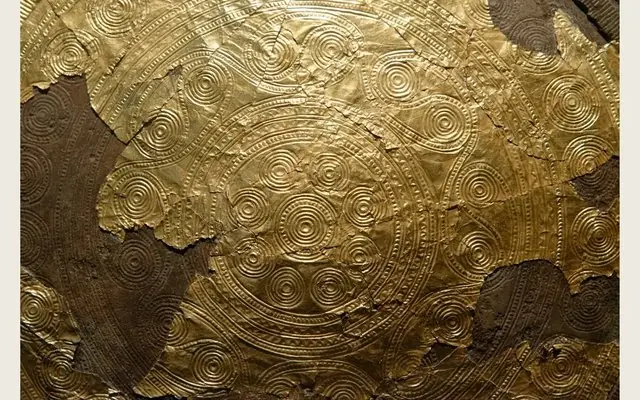
The disc is gilded on one side and decorated with complex patterns. Its spirals are central to the National Museum's attribution of the work to the Danish area. The photograph accompanying this article concentrates on this decorated surface, rather than showing the entire horse-and-disc assembly. Looking closely reveals why the object can be studied as accomplished metalwork as well as religious imagery. Its visual effect depends on the contrast between materials, the organization of ornament, and the relationship between a carefully worked surface and the larger mobile arrangement of which it forms a part.
What the solar interpretation can explain
The usual interpretation identifies the disc as the sun and the horse as the being that draws it through the sky. The National Museum presents the sculpture in those terms. The contrast between the gilded face and the darker reverse has also been interpreted through the difference between day and night. Such readings are plausible explanations of the design, not translations of a surviving Bronze Age caption. Keeping that distinction clear allows the object to remain meaningful without claiming direct access to every belief held by the people who made or used it.
More elaborate proposals connect the number and arrangement of decorative circles with calendrical knowledge. These hypotheses have attracted attention because repeated motifs invite counting and comparison. A numerical pattern, however, does not establish a working calendar simply because a modern calculation produces an interesting result. The sculpture gives strong evidence of deliberate design; identifying the exact system behind that design requires additional argument. The most useful approach is therefore to separate the observable pattern from the explanation offered for it, rather than presenting a disputed reconstruction as the object's securely known operating instructions.
A surviving sculpture without an instruction manual
The Sun Chariot also has a modern history of reproduction and display. A lantern slide in the University of Cambridge's Museum of Archaeology and Anthropology records the object in a museum context, illustrating how prehistoric artefacts entered teaching collections through photographs. Such records show another way that objects travel: their images circulate even when the originals remain elsewhere. A photograph can direct attention to one feature, preserve an earlier display arrangement, or reduce a three-dimensional construction to a single viewpoint. It is evidence about the represented object and about the later practices through which people encountered it.
The attraction of the Trundholm sculpture lies partly in this combination of clarity and uncertainty. Its horse and shining disc are immediately legible as an organized image, while the ceremony, narrative, or teaching practice behind them remains incomplete. That incompleteness does not make interpretation pointless. It makes careful distinctions necessary. Material analysis, comparison, museum documentation, and observation each contribute something different. Together they allow a small surviving object to illuminate Bronze Age skill and imaginative thought without requiring a modern storyteller to invent the words that its makers never left for us to read.