A field becomes an archaeological investigation
The Staffordshire Hoard is often introduced through the quantity of its precious metal. Its more demanding story begins with things that are missing: blades, wooden grips, original attachments, and the circumstances that brought so many detached fittings together. The discovery in 2009 near Hammerwich, England, revealed an extraordinary concentration of Anglo-Saxon metalwork. Yet it did not uncover a room full of complete weapons or a grave with a named occupant. Much of the collection consists of fragments. Reconstructing their relationships requires careful observation rather than allowing the glitter of gold to provide its own explanation.
Terry Herbert found the first material while metal detecting in a cultivated field in July 2009. He contacted the Portable Antiquities Scheme's local finds liaison officer, Duncan Slarke. Kevin Leahy's initial assessment records the subsequent involvement of museums, heritage authorities, and archaeological investigators. A controlled excavation followed during July and August. That sequence transformed an exceptional individual find into a recorded investigation. The difference matters because the distribution of material and the circumstances of recovery can answer questions that the objects, removed from their setting and viewed separately, cannot resolve on their own.
Fragments with histories before burial
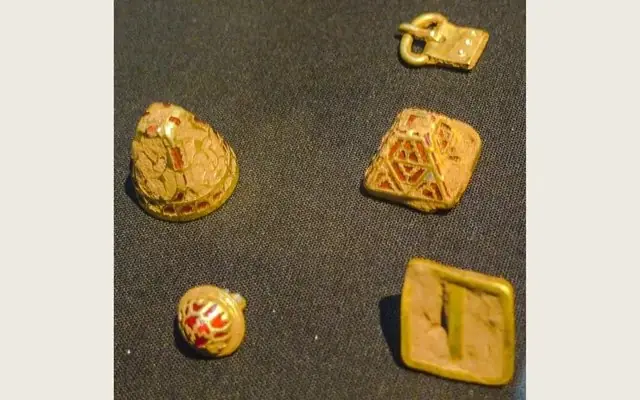
Many pieces had already been bent, broken, or separated from larger objects before burial. An observer looking only for intact treasures might therefore underestimate the collection. A sword pommel cap, for example, once belonged at the end of a grip. A thin decorative plate had a different function from a blade, even when both were part of the same weapon. The accompanying photograph shows pommel caps from the hoard. These are actual fittings, not miniature swords, and their survival illustrates how conspicuous ornament can remain after other components have disappeared from the archaeological record.
Leahy's report is especially useful because it records a discovery still under examination. Soil blocks were radiographed to locate small metal fragments before detailed work proceeded. Initial identifications sometimes remained tentative, particularly for pieces that might belong to helmets. The report also distinguishes material belonging to the hoard from recent debris recovered in the same field. An archaeological collection is not defined simply by everything a detector locates nearby. Investigators have to establish associations, identify intrusive objects, and preserve uncertainty when an attractive interpretation runs ahead of the available physical evidence.
Reading workmanship without inventing an owner
The workmanship rewards close attention. Garnets set within metal cells, fine filigree, and interlaced animal decoration transformed small fittings into highly elaborate objects. These techniques imply skilled production, but they do not identify an individual craftsperson or establish a single workshop for the whole deposit. Different parts may have had different places and dates of manufacture. What survives is evidence of decisions about materials, surfaces, and visual effect. The richness of the decoration also explains why removing a fitting from its original setting changed more than the physical completeness of a weapon.
Most of the collection relates to war gear, although Christian crosses and an inscribed gold strip complicate a purely military description. The unusual selection has encouraged explanations involving booty, gathered wealth, or ceremonial action. Such proposals should remain proposals where evidence does not settle the matter. A martial assemblage is not, by itself, a record of one battle. Nor does the location automatically supply the identity of a person who buried it. The strongest account separates what an object demonstrably is from the larger historical scene that a modern viewer might imagine around it.
An expanding record rather than a finished inventory
Birmingham Museums now summarizes the collection as just under four thousand objects and broken fragments, most associated with war gear, and places its burial in the seventh century. The earlier assessment used a smaller working inventory and broader initial dating. Those descriptions should not be treated as competing counts of an unchanged set of complete possessions. Cleaning, identification, additional recovery, and the recognition of fragments affect cataloguing. The early report preserves the investigation's starting point; the later museum account reflects subsequent work. Reading them together makes the development of knowledge visible instead of concealing it behind a single impressive number.
The Staffordshire Hoard ultimately offers a lesson in how much can survive in broken form. Small pieces can reveal sophisticated decoration and the selective dismantling of larger objects, while still refusing to name their owners. Conservation and research make those pieces more intelligible without turning every uncertainty into a solution. Looking at a pommel cap as part of a former assemblage encourages a different kind of attention from looking at gold as an isolated commodity. The valuable historical question becomes not only how much metal was hidden, but what happened to the objects before their fragments entered the earth.