A discovery with more than one layer
A buried treasure can seem to offer an immediate explanation: somebody hid valuables and never returned. The Galloway Hoard makes that explanation feel incomplete. Discovered in southwest Scotland in September 2014, it brought together silver, gold, unusual containers, and delicate organic materials. The deposit belongs to around AD 900, but its contents had different histories before they entered the ground. Some could be treated as precious metal; others were carefully protected objects. Understanding the discovery therefore requires attention to the arrangements that held the collection together, not simply to its most glittering pieces.
National Museums Scotland describes a collection of more than one hundred objects, with over five kilograms of silver, gold, and other materials. Metal detectorists made the discovery near Kirkcudbright, and archaeological excavation followed. The museum acquired the hoard in 2017. These modern stages matter because a discovery does not arrive as a finished historical account. Recording, stabilization, acquisition, and research determine what can be learned from fragile associations. Objects that look independent in a display case may once have touched, enclosed, or protected one another in the deposit.
Why the wrapping belongs to the story
The survival of textiles and leather made those relationships unusually informative. Material wrapped around a valuable object can be easy to overlook when attention falls on metalwork. Here, the wrappings helped preserve evidence of how the collection was prepared. The museum's research project combined archaeological investigation with specialist study of organic remains. Its emphasis was not merely on identifying fabrics as expensive or rare. The sequence of bundles and containers also offered clues to acts of selection and protection that occurred before burial, even when the identities of the people responsible remained unknown.
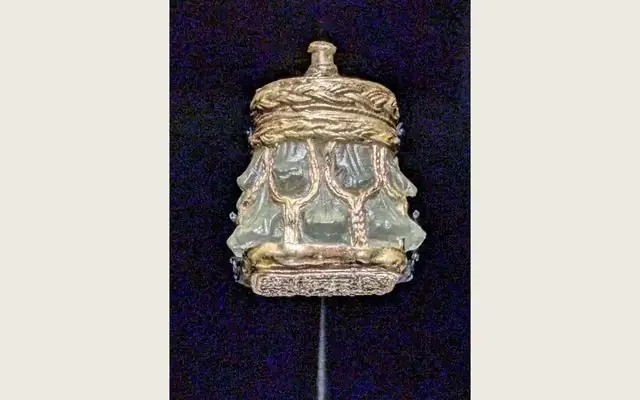
Preliminary conservation by AOC Archaeology included radiography and material analysis, allowing investigators to examine objects before disturbing their coverings. Its account describes high-quality textiles, hidden gold objects, and a small crystal vessel. Such work requires a balance between access and preservation. Cleaning may reveal a surface, while excessive removal can destroy the relationship between that surface and surviving fabric. The accompanying photograph shows the rock crystal jar from the hoard, rather than the much larger lidded silver vessel. Keeping those two objects distinct is essential when following the discoveries made during conservation.
An object that travelled farther than expected
The larger vessel provided a striking example of interpretation changing with new evidence. An early conservation account described it as Carolingian. In September 2024, National Museums Scotland announced research identifying a West Asian origin. Laser cleaning exposed imagery including animals, crowns, and fire altars. Analysis of the metal and its dark inlay supported a connection with what is now central Iran. The revised attribution did not result from a newly discovered label explaining the vessel's travels. It emerged from a combination of decoration, materials, and comparison with other historical evidence.
This distant origin establishes a connection, not a complete itinerary. An object could pass through several owners and systems of exchange before reaching Scotland. The hoard does not reveal every transfer or prove that its final keeper personally travelled to Iran. Nor does its Viking-age date require every object to have been made in Scandinavia. Older possessions, Christian objects, bullion, and goods with distant origins could share a single deposit. The collection makes the period more complicated than a story organized only around raiding, while leaving the precise mechanisms of many connections open.
Questions that survive the conservation laboratory
The museum's interdisciplinary project, active from 2021 to 2024, treated this variety as a research opportunity. Textiles, metal composition, inscriptions, and the nesting of objects contribute different kinds of evidence. They also operate on different timescales: manufacture, reuse, wrapping, and burial need not belong to one moment. Bringing those timescales together gives an object a history rather than merely a date. It explains why the results can continue to develop years after discovery and why an early description should remain distinguishable from a later, better-supported conclusion.
Who assembled the Galloway Hoard, why it was buried, and why it remained underground cannot be answered with certainty. That uncertainty is part of its historical value. The objects offer unusually detailed evidence of care, movement, and accumulated meaning without supplying a named protagonist for every action. Their story asks visitors to look beyond the quantity of precious metal toward the fragile things that survived beside it. A scrap of wrapping can record a relationship that a polished object alone would never disclose, turning conservation into a way of recovering actions as well as treasures.