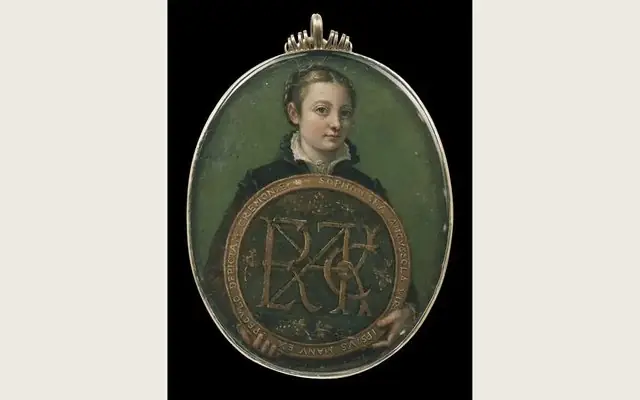
An artist makes herself the subject
A self-portrait gives an artist a special kind of double role. She chooses how to appear while also demonstrating the skill needed to make that appearance convincing. Sofonisba Anguissola used that relationship repeatedly in the sixteenth century. Her own likeness could communicate education, restraint, social position, and artistic ability within the same small surface. The result was more than a face preserved for later admirers. It was a considered presentation of a woman whose opportunities depended on talent working within the expectations and advantages of a particular family and social world.
Anguissola grew up in a patrician family in Cremona, with a father who supported his daughters' education in the arts. The French Ministry of Culture describes her training with Bernardino Campi and Bernardino Gatti, and the recognition her portraiture brought. That setting matters because access to artistic learning was uneven. A supportive household and connections could create opportunities that were unavailable to many women. The history becomes clearer when those resources are acknowledged alongside individual accomplishment, rather than treating success as proof that the ordinary restrictions of the period had ceased to matter.
A name and a book in a small portrait
In the self-portrait dated 1554 now in Vienna's Kunsthistorisches Museum, she holds an open book that names her and identifies her as the maker. The museum emphasizes the combination of modest presentation and confidence. The book works within the picture as an object associated with learning, while its inscription connects the represented person to the act of representation. A viewer is asked to see both the sitter and the painter. Such a claim can be quiet and still be unmistakable, especially when the image itself supplies a demonstration of the ability being asserted.
The small scale strengthens the need for close attention. The Vienna painting is on poplar and measures roughly 19.5 by 14.5 centimetres. That is an object encountered at a different distance from a large ceremonial portrait. Its restrained appearance does not make it artistically unambitious. Expression, the position of the hands, clothing, and the relation of the book to the figure all contribute to the self-presentation. Naming the support and dimensions helps restore this physical encounter when a digital reproduction can otherwise make every picture seem to occupy the same space.
A different image near the Spanish court
A later self-portrait in the Pinacoteca di Brera creates a different impression. Dated 1560–61, it is associated by the museum with the beginning of Anguissola's extended period at the Spanish court. Elaborate dress, embroidery, fur, and jewels receive concentrated attention. The museum links that precision with the close observation characteristic of her work. Read beside the Vienna picture, the portrait shows that self-representation did not have to repeat one fixed formula. A change in circumstances could invite a different balance among refinement, social visibility, and the artist's command of detail.
At the Spanish court, her position included service to Queen Elisabeth of Valois as a lady-in-waiting and drawing teacher. The Ministry of Culture's account makes those roles explicit. Describing her simply through the modern image of an independent studio professional would therefore obscure how the career actually worked. Courtly service, personal relationships, and portrait production could overlap. Her prominence was considerable, yet it existed within arrangements governing status and behavior. That combination is part of the history, rather than a complication that needs to be removed to make the achievement impressive.
Looking across objects without confusing them
The image accompanying this story is another object again: a miniature self-portrait from around 1556, held by the Museum of Fine Arts, Boston. It is painted in oil on parchment and must not be confused with either the Vienna panel or the Brera canvas. Bringing several self-portraits together is useful precisely because their materials, scale, and presentation differ. The familiar artist's name does not turn them into interchangeable illustrations. Each preserves a particular decision about how a likeness should be made and what a viewer should notice within it.
Anguissola continued to be respected into old age, and her long career resists being compressed into a single exceptional image. Her self-portraits offer a practical route into that larger history because they make authorship visible inside the representation. They ask the viewer to recognize a cultivated woman and an accomplished maker at once. The force of that combination remains available without inventing a modern declaration for her to have spoken. The evidence is already in the work: a chosen pose, an inscribed book, an exacting treatment of dress, and a likeness deliberately made by its own subject.