A famous name on a substantial scholarly task
A translation can become so familiar that readers stop noticing the person who made it possible. Elizabeth Carter's 1758 edition of Epictetus offers a reason to look again. The book brought surviving works associated with the Greek philosopher into English, accompanied by an introduction and notes. This was a substantial undertaking, not the casual substitution of one set of words for another. Its history connects learning, patient revision, correspondence, and the practical arrangements of publication. Carter's reputation rested on a work that allowed readers without her linguistic training to encounter a difficult older text.
Born in Deal in 1717, Carter received instruction from her father, Nicholas Carter, a clergyman with knowledge of classical languages. The historical Dictionary of National Biography describes the persistence involved in her education and the range of languages she later studied. That account belongs to an older style of biography and should not be mistaken for an unmediated diary. Nevertheless, it documents a career built on sustained learning. The achievement was not simply to be recognized as an unusually learned woman; it was to put acquired skills to use in writing that other people could read.
Learning and translating before the celebrated book
Her activity in print began before the famous philosophical translation. She contributed verse to the Gentleman's Magazine and published a collection of poems in 1738. In 1739, translations from French and Italian appeared, including a version of Francesco Algarotti's dialogues explaining Newtonian philosophy to women readers. These earlier projects show that translation was already part of her literary practice. Different works brought different problems of subject, language, and audience. The later Epictetus did not emerge from an otherwise empty career but from experience in communicating material across linguistic and intellectual boundaries.
The biography dates the beginning of her Epictetus translation to 1749 and the completion of an initial version to 1752. It describes sheets sent to her friend Catherine Talbot as the work progressed. The distinction between completing a manuscript and publishing a book matters here. A text could circulate within a trusted exchange before it was ready for a wider public. Advice and encouragement helped shape the eventual volume, while the introduction and notes gave readers a way into material whose meaning could not be carried entirely by a translated sentence on its own.
From manuscript sheets to a public edition
The 1758 publication was supported by subscription. That arrangement connected the scholarly labor to a community prepared to obtain the finished book. Its full title, preserved in the Wellcome Collection's catalogue, specifies the Discourses transmitted by Arrian, the Enchiridion, and fragments. The wording about surviving works is important: the volume did not claim that every word ever spoken or written by Epictetus had somehow been recovered. Its structure presented a particular body of inherited material, with Carter's contribution explicitly identified as translation from Greek and the provision of explanatory apparatus.
Chawton House places Carter within the Bluestocking world of literary conversation and friendship. Such connections helped women participate in intellectual life, but participation should not be reduced to sociability alone. The substantial book still required linguistic judgment and the ability to maintain a long project. Carter's example brings those elements together. Conversation could support scholarship without replacing it, and a published translation could turn learning developed in a relatively private setting into something available well beyond the immediate circle that had encouraged its production.
A reputation preserved in books and portraits
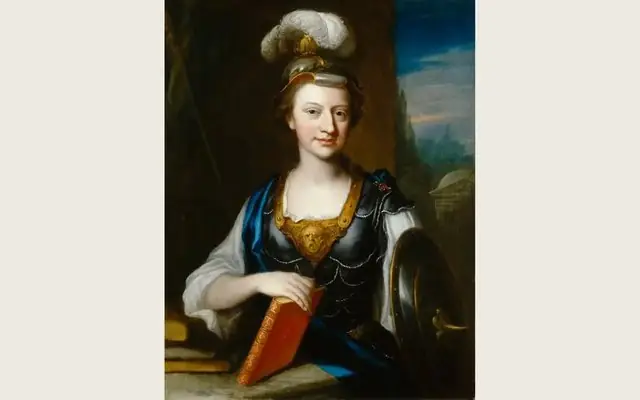
Her reputation also acquired a visual form. John Fayram's portrait presents Carter as Minerva, using a classical figure associated with wisdom to frame a contemporary learned woman. It is an imaginative representation of status, not evidence that she dressed that way while translating. Later books provide another form of remembrance: Chawton holds the 1807 Memoirs edited by her nephew Montagu Pennington. Portrait and memoir preserve different constructions of a life. Reading them beside the 1758 volume helps keep the intellectual work itself in view rather than letting fame become detached from what produced it.
Carter died in 1806, leaving poems, prose, correspondence, and the translation for which she remained especially well known. The most useful way to remember that achievement is neither as a miracle of isolated genius nor as a name borrowed to decorate a history of learned women. It was a sequence of activities: studying languages, trying earlier translations, sustaining an exchange of manuscripts, revising, explaining, and finding readers. The finished volume made those efforts less visible to its audience, precisely because they had succeeded in making someone else's difficult words more accessible.