A flying machine begins as a set of questions
To design a machine that flies, it is useful to stop treating flight as one indivisible action. George Cayley helped make that separation productive. A wing could supply lift while another arrangement provided propulsion, and a tail or other control surfaces could help govern the result. These functions had to work together, but they could also be studied as different problems. The significance of Cayley's work is therefore not confined to a spectacular flight. It includes a way of organizing the question that made experiments, models, and later designs easier to compare.
Cayley lived from 1773 to 1857 and pursued flight alongside many other technical interests. The Science Museum Group's biographical account describes his investigations of wing design, stability, streamlining, and control. Those subjects did not wait for a convenient engine to become available. An investigator could ask how a surface behaved in air or how an arrangement maintained its attitude without having solved every difficulty of sustained powered travel. Dividing the larger ambition into questions allowed work to proceed where an attempt to build a complete successful machine all at once might simply have failed without explanation.
What a small engraved object preserves
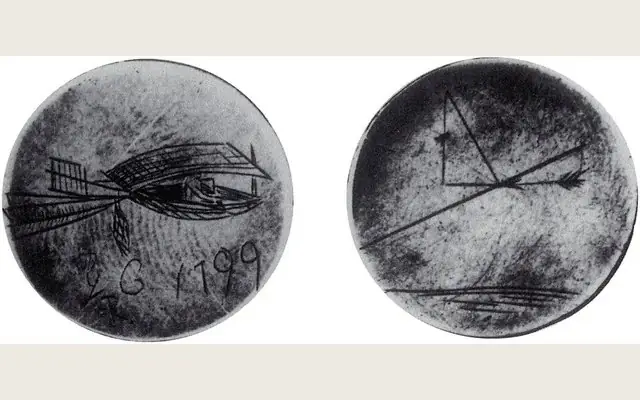
A small silver disc makes the early stage of that thinking unusually tangible. The Science Museum Group dates the object to 1799, identifies its material as silver, and records a diameter of 25.4 millimetres. Its engraved design belongs to an ambition far larger than the object itself. The image reproduced here presents the disc's two sides, including a flying-machine design and a diagram concerned with forces. The object is evidence of ideas being represented compactly, not evidence that a working full-size aircraft with those exact features had already been built and flown.
That distinction between representation and demonstration is essential to reading early technology. A drawing can separate functions and propose relationships, but actual behavior has to be investigated in material arrangements. A model can expose a weakness or confirm a possibility without reproducing every condition faced by a larger machine. Cayley's surviving design belongs within that movement between ideas and tests. Its importance is increased, rather than diminished, by recognizing what it does not establish. A clear proposal can be a major step while remaining a proposal that still demands further experimental work.
Models, gliders, and the limits of a demonstration
The Science Museum Group records a successful glider model in 1804 and relates Cayley's later work to a full-scale glider carrying a person in 1853. Such stages should not be collapsed into a modern powered flight. A glider can demonstrate lift, stability, or aspects of control while depending on different conditions for its motion. The distinction prevents a race for a single first from obscuring what different experiments were actually testing. An achievement becomes more intelligible when the question it answered is stated as carefully as the year assigned to it.
Cayley also communicated his reasoning in print. The San Diego Air and Space Museum identifies On Aerial Navigation as a three-part publication of 1809–10, discussing a fixed wing, propulsion, and a controlling tail. Publishing could make an arrangement available for criticism and development beyond the inventor's immediate setting. It also preserved a relationship between a proposed configuration and the reasons for choosing it. A later reader does not have to reconstruct the investigation only from the outline of an old machine; written explanations can show how its designer divided the problem and evaluated possible solutions.
A long investigation rather than a single leap
Modern museum reproductions add another layer of evidence. San Diego's glider was built by James Sproule using Cayley's mid-nineteenth-century drawings and was donated to the museum in 1994. A reproduction can help visitors understand the scale and arrangement of a historical design. It must still be identified as a later object. Its construction or performance does not become a substitute for the original documentary record. Keeping those layers distinct allows a museum display, an engraved disc, and a historical text to contribute different kinds of information without being mistaken for the same occasion.
Cayley's history is most useful when it remains a long investigation rather than a single inspired leap toward an inevitable result. Separating lift, propulsion, and control did not solve every problem of aviation. It supplied a framework in which the problems could become more specific and the results of different experiments more informative. The tiny silver disc is memorable because it preserves that act of organization. Before a practical aircraft could carry people routinely, someone had to make the ambition precise enough that its parts could be drawn, discussed, tested, and changed.