Two streets arranged as a comparison
An image can make a comparison before its viewer has read a word. William Hogarth's Beer Street and Gin Lane, issued as a pair in 1751, arrange contrasting city scenes so that one helps explain the other. Activity and apparent prosperity occupy one print; disorder and neglect dominate its companion. The relationship makes them a visual argument rather than two unrelated views of London. To understand the prints, it helps to ask not only what they show but why particular details were selected and what conclusion the comparison was meant to encourage.
Hogarth worked as both a painter and a printmaker, and London supplied many of his subjects. London Museum describes his ability to reach a wider audience through engraved images and to combine moral criticism with humor. A print could circulate beyond the location of a painting, bringing a carefully organized scene to viewers in different places. This material form matters to the story. The argument was designed to travel on paper, where figures, signs, buildings, and small incidents could remain available for repeated examination after a first impression had already taken effect.
Reading the apparently prosperous scene
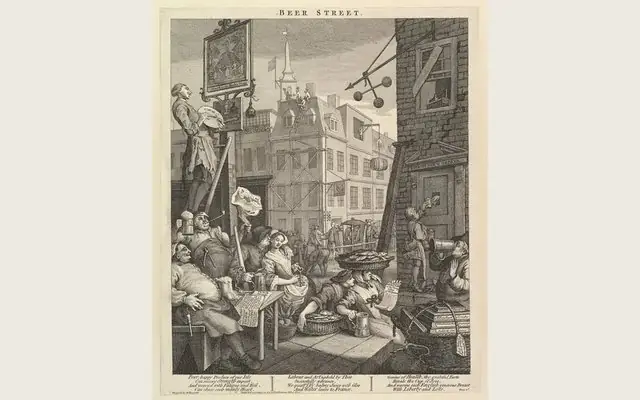
Beer Street rewards that slower reading. People associated with trades and labor appear well fed, occupied, and able to enjoy themselves. The Met's impression preserves the dense arrangement of figures and architecture through which the scene acquires its confident energy. A sign painter, workers, food, and vessels for drinking draw the eye through different parts of the street. The image offers a version of urban life in which consumption and useful activity appear compatible. That compatibility is a pictorial proposition: Hogarth has chosen how the people and their surroundings are made to reinforce each other.
The pawnbroker introduces a sharper part of the comparison. The National Galleries of Scotland notes that this business is the conspicuous exception to the scene's prosperity. Its difficulty helps make the apparent health of the community legible through the fate of a particular trade. The neighboring details are therefore doing more than filling empty space. A building, a sign, or the condition of a business can be assigned a role in an argument about the whole street. Looking closely changes the picture from a general bustle into a set of relationships arranged to support a conclusion.
A printed image enters public debate
Gin Lane reverses that arrangement through a deliberately distressing representation of social breakdown. London Museum places the pair within a campaign concerning spirits and taxation, while the National Galleries connects it with the Gin Act of 1751. This context prevents the images from being mistaken for neutral surveys of two actual neighborhoods. They were interventions in a debate. Hogarth compressed problems into scenes that could be grasped and remembered, making the consequences he wanted viewers to associate with particular kinds of drinking unusually visible and dramatically different from one another.
The opposition also carried cultural assumptions. The National Galleries explains that beer was presented as a national drink, in contrast to gin's continental associations. Recognizing that element makes the comparison more complicated than a timeless public-information message. The prints speak through the preferences and anxieties of their setting. They can be studied for their persuasive construction without accepting the contrast as an adequate modern account of alcohol or of poverty. Historical interpretation requires keeping the maker's intended judgment distinct from the much broader reality that the judgment claims to explain.
Historical evidence with a point of view
The object reproduced here is a Met impression of Beer Street, catalogued as an engraving in its third state. A state identifies a stage in the alteration of a printing plate; it is not simply another name for the composition's original date. Such collection details matter because an image known through many reproductions can otherwise lose its material history. Different surviving impressions and catalogue descriptions belong to particular objects. The accompanying image shows one of those objects, while the paired argument must be reconstructed through attention to both compositions and their historical purpose.
Hogarth's achievement lies partly in how efficiently he makes looking become judgment. The eye encounters bodies, tools, buildings, and businesses, then assembles them into a story about society. That makes the prints valuable historical evidence, but evidence with an unmistakable point of view. They tell us about the problems their maker wanted to expose and the visual means he used to expose them. Reading the two streets together preserves their force while leaving room for a necessary question: what has a persuasive image made easy to believe, and what has it left outside the frame?