A familiar place becomes a subject
A place does not have to be distant to contain things worth finding out. Gilbert White made that possibility the basis of a lasting book. The Natural History and Antiquities of Selborne, published in 1789, drew attention to a Hampshire parish through its plants, animals, weather, and human setting. Its scale was local, but its questions were not necessarily small. What appeared at a certain season? How did a living creature behave? What had actually been seen, and what was only an explanation proposed to account for an incomplete observation?
The opening description of Selborne gives the reader much more than a picturesque name. White distinguishes slopes, woods, soils, springs, and different kinds of ground around the village. These details make the landscape a setting in which particular observations can be understood. A bird, tree, or water supply belongs somewhere, and that somewhere influences the questions an observer can ask. Reading the description today also reveals a method of attention. White does not need the parish to be uniformly beautiful or scientifically exceptional before treating its differences as worth recording.
Observations that need dates as well as names
Repeated visits add something a single excursion cannot supply. The Natural History Museum describes White's journals and records of plants coming into flower, alongside notes on animals and seasonal events. A date turns an observation into something that may later be compared with another date. The significance is not simply that a record is old. It preserves a relationship among an observer, a place, and an occasion. Without those relationships, a remembered impression that spring came early or a bird arrived late is much harder for another person to examine.
White's interests also reached creatures that were easy to overlook or regard as troublesome. His discussion of earthworms considered their relationship with vegetation and the movement and condition of soil. The point was not that a familiar animal had suddenly become exotic. Close attention could make its ordinary activity consequential. This approach encourages a reader to notice relationships rather than merely assemble a list of names. A garden or field then becomes a place of interactions, in which apparently minor organisms can help explain processes that would otherwise remain taken for granted.
A local observer in a wider conversation
The book's letter form connects local attention to a wider exchange. The first-edition catalogue identifies letters addressed to Thomas Pennant and Daines Barrington, revised for publication. That qualification matters: the finished work is not an untouched packet of private messages accidentally printed together. Correspondence supplied an audience for questions, comparisons, and reports, while publication gave that exchange a new arrangement. White could remain closely associated with Selborne without being intellectually isolated there. Information from elsewhere helped test the meaning of what he encountered nearby and exposed gaps in what local watching alone could establish.
The primary text preserves uncertainty as well as knowledge. Questions about seasonal birds required White and his correspondents to consider sightings beyond their immediate surroundings. An absence from one place did not itself explain where an animal had gone. This makes the book more useful as a history of investigation than as a collection of conclusions that all need to match present understanding. Its value includes the distinction between a report, a comparison, and a conjecture. An attentive observer can be influential without every proposed explanation surviving later scrutiny.
Reading a record without making it infallible
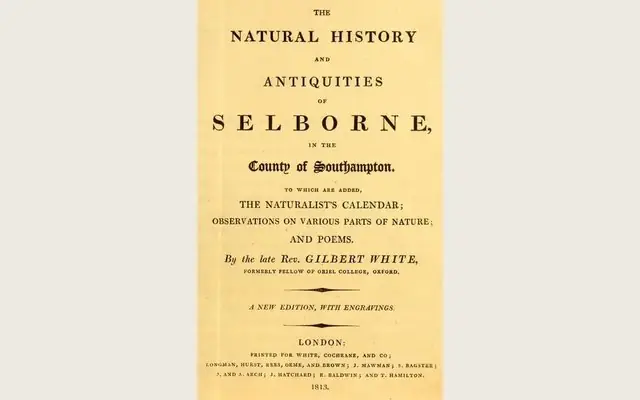
Objects associated with the publication bring another kind of time into view. The image accompanying this story comes from the title page of an 1813 edition, not the 1789 first printing. Later editions show how the work acquired readers beyond its original occasion. A catalogue record helps keep those editions separate, while the text allows the observer's questions to be read again. The illustrated book is evidence of transmission as well as observation: printers, editors, and readers all participated in carrying a local natural history into a much longer public life.
White's example remains inviting because it makes curiosity possible at an ordinary distance. It does not imply that modern environmental research can dispense with its own instruments, methods, or wider comparisons. Rather, it restores the importance of returning, noticing, dating, and distinguishing what is known from what is suspected. A village could contain enough variation to occupy a lifetime of inquiry. The enduring achievement of Selborne is to make that proposition persuasive without requiring the reader to leave the familiar world behind before beginning to look at it more carefully.