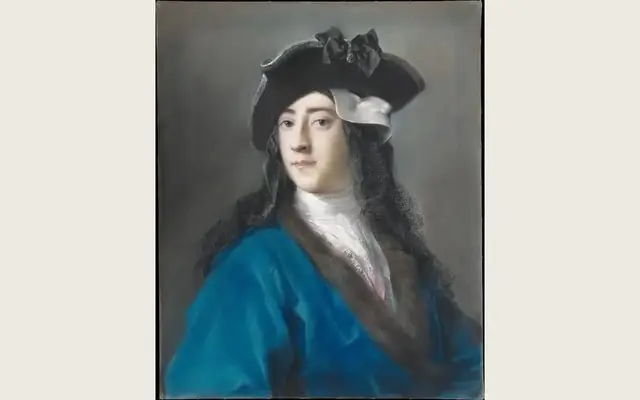
A portrait that carries a visit to Venice
A visitor can carry home an object that preserves more than a likeness. In Rosalba Carriera's portrait of Gustavus Hamilton, clothing connects a recognizable individual with the experience of Venetian Carnival. The combination of hat, veil, mask, and short cape belonged to the city's masquerade culture. Carriera made that association visible in pastel, a material whose surface could look remarkably rich while remaining physically delicate. The picture is both a portrait and evidence of an encounter between a visiting patron, a particular city, and an artist with an international reputation.
The Metropolitan Museum dates the work to 1730–31 and identifies Hamilton as the second Viscount Boyne. He visited Venice during the winters of those years with Edward Walpole. Knowing that context does not require treating the portrait as an unplanned glimpse of a street scene. A sitter's costume could be deliberately selected for representation, allowing the finished work to communicate an experience and a social identity together. The portrait makes travel visible through what a person wears, rather than by placing a famous building or a map behind the figure.
Powder, paper, and the effect of painted color
Carriera, who lived from 1673 to 1757, became especially associated with pastel portraiture. The medium uses powdered pigment combined with a binder and formed into sticks. Its colored material adheres to the support rather than becoming an oil-paint film. That physical difference contributes to its characteristic visual effect and to its vulnerability. A soft-looking transition of tone is therefore not just an image of softness. It also results from the behavior of a material whose handling, support, and preservation have to be considered alongside the sitter's face and costume.
The Met's history of the medium describes an eighteenth-century shift in which pastel increasingly competed with conventional painted portraits. Carriera's pictures were collected by European courts and by travelers visiting Venice. Their importance was not that pastel had never been used before. It was that an artist could build a celebrated portrait career around it and expect finished works to command attention on display. This distinction keeps the story from becoming a simplistic invention claim. A medium can acquire new prestige through the scale, purpose, and reception of works made in it.
The miniature behind a larger reputation
Another object in the Met reveals a more intimate side of Carriera's practice. Portrait of a Man, dated around 1710, is a miniature on ivory. The museum explains how she used the pale support for skin tones, applied small dots of paint, and handled other passages with washes. The miniature demands attention to a different relationship between image and viewer. Its small dimensions encourage close inspection. Such an object belongs to a world of portrait-making in which a convincing likeness could be carried or examined at a distance very different from that of a larger displayed pastel.
The connection between miniature and pastel should not make their techniques sound identical. One uses a particular painted support; the other relies on loosely adhering colored particles. Yet both reward control over small distinctions of tone and detail. Reading the objects together reveals an artist choosing among materials rather than merely applying one fixed recipe to every commission. It also prevents the larger reputation from erasing earlier forms of work. A celebrated specialist could arrive at that identity through practices that trained the eye and offered different ways to organize a sitter's appearance.
Looking at a work that remains physically delicate
The Hamilton portrait is especially useful because the surviving object connects those technical questions to a documented occasion. Its costume has recognizable parts, its sitter has a name, and its approximate date belongs to a record of travel. None of those facts cancels the need to look at the handling of light, complexion, and dark fabric. Nor can the image alone recover every conversation between patron and painter. Historical context supplies limits as well as explanation: it helps identify what the picture supports and where an appealing story would begin to outrun the evidence.
Pastel's delicacy adds a final perspective to its success. A work capable of projecting confidence and social ease can depend on a surface vulnerable to disturbance. Its survival involves careful treatment as well as artistic accomplishment. Carriera's portraits invite that double attention: to the people they present and to the material choices that make their presence convincing. The powder is not a preliminary step waiting to become a proper painting. In these finished portraits, it is the means through which an artist fashioned a public career and gave a visitor's experience an enduring visual form.