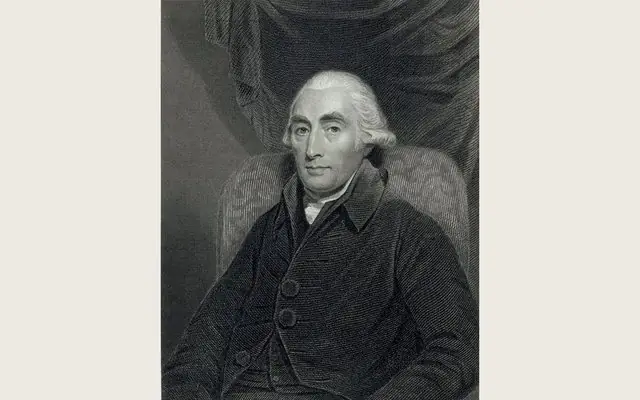
A thermometer leaves part of the story untold
A thermometer supplies a number that is easy to mistake for a complete account of heat. If more heat enters a substance, it seems natural to expect the number to rise. Melting ice complicates that expectation. Energy can go into a change of state while the temperature remains approximately steady under the appropriate conditions. Joseph Black made this distinction a subject of systematic investigation in the eighteenth century. His work helped separate the quantity transferred in heating from the temperature a thermometer records, turning a familiar material change into a demanding conceptual problem.
Black, born in 1728, studied medicine as well as chemistry. His earlier investigations into alkaline substances established the importance of careful measurements of weight and helped characterize the gas he called fixed air, now known as carbon dioxide. This background matters because it places the work on heat within a wider habit of quantitative inquiry. A material could appear familiar while containing relationships that required deliberate experiments to reveal. Black's history was not simply a succession of named discoveries; it involved asking what a measurement could establish about a process hidden behind ordinary appearances.
Following a change of state
At Glasgow, he investigated freezing and melting, including water and mixtures involving alcohol. The University's School of Chemistry describes his attention to heat effects and the development of calorimetry. The puzzle was not that a thermometer failed to work. It was that temperature alone did not describe everything occurring during a phase change. Calling the heat latent provided a way to discuss the apparent discrepancy. The term directed attention toward heat involved in a transformation rather than toward a rise visible on the scale of a measuring instrument.
Boiling presented a related comparison. Supplying heat could produce more vapor without simply driving the temperature of the boiling liquid upward. Together, such observations made it necessary to distinguish changes of state from changes of temperature. Black also worked on specific heats, concerned with differences in how substances respond to heating. These are related ideas rather than interchangeable names. A history that treats them as one vague discovery loses the useful question at their center: what exactly is being compared when equal masses or different materials undergo thermal changes?
Connections without a single-inventor myth
The University of Edinburgh dates Black's description of his heat investigations to a Glasgow philosophical and literary society in 1762. It also emphasizes that he did not publish that work himself. This is an important qualification to a familiar discovery narrative. Scientific ideas could circulate through demonstrations, conversation, lectures, and notes as well as through a research paper. A date attached to a presentation therefore describes one stage of communication, not necessarily the instant when every experiment was first conceived or when every interested person could read a finished printed account.
Black's relationship with James Watt provides another route through which the subject acquired practical importance. University histories and the Dictionary of Irish Biography describe their communication and Black's support. Heat, steam, and efficiency were connected questions, but those connections should not turn Black into the sole inventor of Watt's machinery. Nor should an engineering achievement be reduced to an automatic application of one scientific principle. The relationship is more informative when it preserves exchanges between different kinds of expertise, with experiments and practical problems offering reasons for further questions on both sides.
A discovery carried through teaching
Teaching was a particularly important part of Black's influence. After moving to Edinburgh in 1766, he developed a reputation for lectures illustrated by carefully handled experiments. Student manuscripts and copied notes preserved material beyond the moment of delivery. The Dictionary of Irish Biography records a posthumous collection of lectures published in 1803. These forms of survival remind a reader that the history of an idea includes the people who heard, copied, organized, and later read it. A demonstration can disappear from a room while its explanation continues to travel through other media.
Black's heat investigations remain an excellent reason to distrust an answer that is too quick. The thermometer is useful precisely because it measures something specific, not because it measures everything. Watching ice melt or water boil can therefore become an exercise in defining the question before interpreting the number. Black helped make that distinction productive for science. His legacy lies both in the concepts associated with his name and in an approach that asks which measurements are needed when an apparently simple physical process refuses to fit an initially plausible expectation.