An ordinary surface worth investigating
A basin of used water normally presents a task to finish, not a research problem to preserve. Agnes Pockels found something else in it: a surface whose behavior could change when small quantities of other material were present. Working at home in Braunschweig, she began investigating phenomena that could easily disappear into the routines of washing and cleaning. Her story is compelling because the observations did not remain a charming anecdote about curiosity. She developed an apparatus, made repeated measurements, and eventually brought her results into an international discussion of surface physics.
Pockels lived from 1862 to 1935, during a period when access to scientific education depended heavily on gender and social circumstance. She did not receive a university training. The Neue Deutsche Biographie describes her independent study and the help of her brother Friedrich in obtaining scientific literature. Those details prevent a misleading picture of discovery without learning. Books and sustained attention mattered even when a formal classroom was unavailable. Her domestic responsibilities also continued alongside the work, so the history involves the organization of time as well as the availability of equipment.
A home experiment becomes a measurement
The water surface was an especially revealing place to ask careful questions. A liquid can look much the same while material at its boundary affects what happens there. Surface tension provides one way to describe and measure that behavior. Rather than relying only on a general impression that dirty water acted differently, Pockels needed comparisons she could repeat. The university's account records her development of a trough apparatus in 1882. A simple arrangement could make a difficult subject accessible, provided its user paid attention to conditions that casual observation would leave uncontrolled.
The importance of the apparatus was therefore methodological. It connected a visible or mechanical response with a deliberately prepared surface and a sequence of observations. The same basin was no longer just an object to clean; it could become a place to compare results. This distinction helps explain why modest materials do not necessarily imply modest intellectual work. An instrument's usefulness depends on the question it makes answerable. Conversely, a striking effect observed once is not the same as evidence strong enough for another investigator to assess or attempt to reproduce.
What a published letter could change
Contact with Lord Rayleigh helped the results reach a different audience. On 12 March 1891, Nature published an item titled Surface Tension, introduced by Rayleigh and presenting a translation of Pockels' letter. The journal's accessible preview preserves his assessment of experiments conducted with simple equipment and of their relationship to his own research. It also records his interest in repeating some of the work. This is a useful glimpse of scientific communication: the letter was not merely praised as unusual, but placed beside ongoing questions and possible further experiments.
Publication mattered without magically removing every obstacle. It supplied a route by which results produced outside a laboratory institution could be discussed within scientific print. The German biographical entry records further papers on surface tension, while the university describes a longer program concerned with interfaces and related effects. Her contribution was therefore more than the arrival of one letter on a famous man's desk. Rayleigh's involvement helps explain a particular publication, but the observations, apparatus, and continuing work remain essential to understanding why there was anything substantial to communicate.
Recognition without a simplified legend
Later recognition included an honorary doctorate from the Technical Hochschule in Braunschweig in 1932. That date should not be confused with the beginning of her research, which lay decades earlier. Nor should later developments in surface science be compressed into the claim that one person invented an entire field alone. The historical connection is more precise: Pockels helped establish quantitative ways to investigate surface behavior, and subsequent apparatus developed that line of inquiry. Recognition becomes more meaningful when it is attached to the work actually done rather than to an inflated retrospective title.
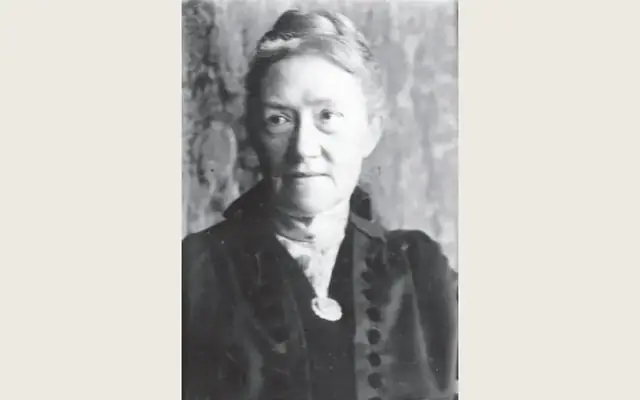
The portrait accompanying this story shows Pockels late in life, not making the first observation in a kitchen. No surviving face can substitute for the experimental reasoning. Her example instead invites a change in how an ordinary setting is read: ask what varies, what remains constant, and what arrangement might make the difference measurable. Domestic work supplied an encounter with the phenomenon; persistent investigation made it science. The transformation lay in turning something usually removed as a nuisance into evidence worth comparing, recording, and sharing with people able to test it.