An argument about learning and independence
What happens when a society praises reason but educates some of its members chiefly to please other people? Mary Wollstonecraft made that contradiction central to A Vindication of the Rights of Woman, published in 1792. Her argument addressed education as a question of independence, character, and public life. It did not merely ask for more accomplishments within an unchanged system. It questioned what that system produced. If people were trained for dependence and display, their apparent limitations could not fairly be used as proof that dependence was their natural condition.
The book belongs to a particular political and intellectual moment. Debates surrounding the French Revolution raised questions about rights, citizenship, and the education suitable for a changed society. The Stanford Encyclopedia of Philosophy explains Wollstonecraft's intervention in discussions of a French educational program that would confine girls to domestic instruction. Her response linked the treatment of women to the coherence of wider claims about human improvement. A project presented as universal became difficult to defend if it withheld the means of moral and intellectual development from a substantial part of the population.
Reading the proposal for education
The primary text rewards attention to what education means within this argument. Wollstonecraft was concerned with habits of judgment and the capacity to act responsibly, not simply with collecting information. Her criticism of decorative accomplishments addressed the priorities behind instruction. A person prepared chiefly to attract approval might learn to anticipate an audience instead of developing independent understanding. This is why the educational question extends beyond a classroom. Family expectations, social rewards, and assumptions about desirable behavior can all teach lessons, including lessons that formally respectable instruction claims to oppose.
In the chapter on national education, she argues for boys and girls learning together and for schooling that allows children to return home. Her discussion connects shared education with encounters among equals and with the relationship between domestic affection and public obligations. These are proposals in an eighteenth-century text, not a description of a system she personally established throughout Britain. Reading the chapter as an argument preserves both its ambition and its limits. It also makes the reader consider how arrangements of everyday learning might shape later relationships between adults.
An author rather than a ready-made symbol
Independence in the Vindication does not mean an absence of duties toward other people. Wollstonecraft repeatedly connects it with virtue and responsible conduct. The language can surprise readers expecting only a modern formula about individual choice. It reflects an effort to show that dependence damages moral relations as well as restricting opportunity. A relationship organized around unequal power can distort the conduct of those exercising it, too. That feature gives her critique a social reach: educating women differently would require rethinking expectations that also structure men's behavior and judgment.
Her career should likewise be approached through writing rather than reduced to a single famous label. The Stanford account places political works beside educational writing, reviews, translations, and fiction. These forms involved different audiences and kinds of argument. The 1792 Vindication was also distinct from her earlier Vindication of the Rights of Men, published in 1790. Keeping the titles and dates separate prevents two interventions from being merged into one vague revolutionary book. It restores the author as someone working through successive public disputes rather than producing an isolated statement outside historical circumstances.
A portrait that belongs to another moment
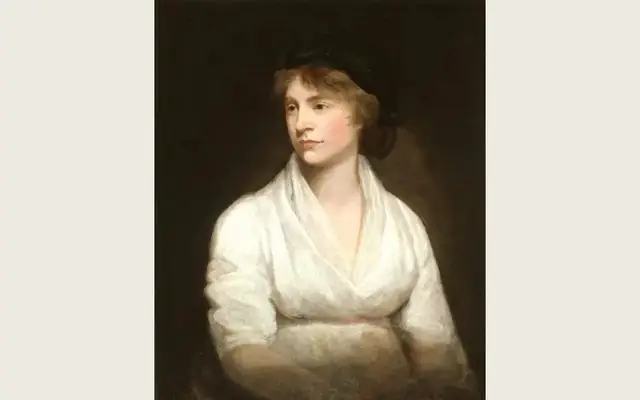
John Opie's portrait offers a face often associated with this body of thought, but it belongs to a later moment. The National Portrait Gallery dates its oil painting to around 1797, several years after the Vindication appeared. It is therefore not an image made to document the book's publication in 1792. The distinction is small but useful. Illustrations can silently collapse time when a familiar portrait is placed beside a famous event. Identifying the painter and approximate date lets the image remain evidence of its own occasion while accompanying the earlier intellectual story.
The enduring force of Wollstonecraft's educational question lies in its invitation to inspect a circular argument. Institutions can restrict the development of abilities and then cite the resulting differences to justify those restrictions. Recognizing that pattern does not require pretending every detail of her proposals matches present expectations. A historical text is more demanding when its particular language and assumptions remain visible. Read on those terms, the Vindication offers both a powerful challenge to unequal education and a record of how one writer connected learning, independence, and the possibility of a better common life.