A familiar sign with an unfamiliar beginning
Few written marks now look less surprising than an equals sign. Two short horizontal lines can connect an elementary sum or a complicated expression without requiring a sentence between them. That familiarity is precisely what makes its history worth noticing. In 1557, the Welsh mathematical author Robert Recorde proposed parallel lines as a convenient way to indicate equality in The Whetstone of Witte. He did not invent the relationship between equal quantities. He offered readers a compact notation for something that already required explanation, comparison, and repeated expression.
Recorde's career joined fields that modern readers often keep separate. The Dictionary of Welsh Biography and the University of St Andrews describe a man trained in medicine who also wrote about mathematics. His books helped make technical knowledge available in English. That choice mattered to readers whose access to scholarly languages varied. Teaching through print required attention to vocabulary as well as calculation: a page had to introduce procedures, explain unfamiliar terms, and make its instructions usable when an expert was not present to answer every question.
What the two lines were meant to do
The Whetstone of Witte dealt substantially with algebra, including the handling of expressions and equations. Repeatedly writing that one quantity was equal to another consumed space and interrupted the movement between operations. Recorde's proposed parallel strokes addressed this practical inconvenience. His explanation connected their equal length and parallel arrangement to the idea he wanted them to represent. The historical mark was longer than the compact sign commonly printed today. Recognizing that appearance helps a reader find the proposal on a sixteenth-century page instead of looking only for modern typography.
The logic was memorable, but it was still a convention. Two lines do not announce their mathematical meaning independently of a reader's training. In another context they might be decoration, a boundary, or part of a diagram. An author therefore had to explain the sign before relying on it. That small moment of instruction exposes a feature hidden by familiarity: notation saves words after its meaning has been established. The apparent simplicity of an equation depends on a community that has learned how to read the marks and what relationships they assert.
A convention still needed readers
Adoption did not follow automatically from the availability of a printed proposal. MacTutor's history of relation symbols describes a longer period in which different ways of indicating equality circulated. Words, abbreviations, and alternative marks could continue to make sense to their own readers. A useful sign still needed repetition in books and teaching before it became an ordinary expectation. It is therefore misleading to picture the publication of 1557 as a switch instantly changing every mathematical page. The event belongs to a history of gradual shared usage as well as individual invention.
Recorde's educational project was broader than this one symbol. His mathematical writings addressed readers learning how numbers and procedures worked, and their explanatory form belongs beside the notation itself. A new mark could shorten one step without removing the need to understand that step. This remains a useful distinction when reading old textbooks: difficulty may come from unfamiliar lettering or language rather than from an absence of mathematical reasoning. Conversely, translating every mark into present-day form can conceal the choices that a historical author was asking readers to make.
A small mark and a larger history of learning
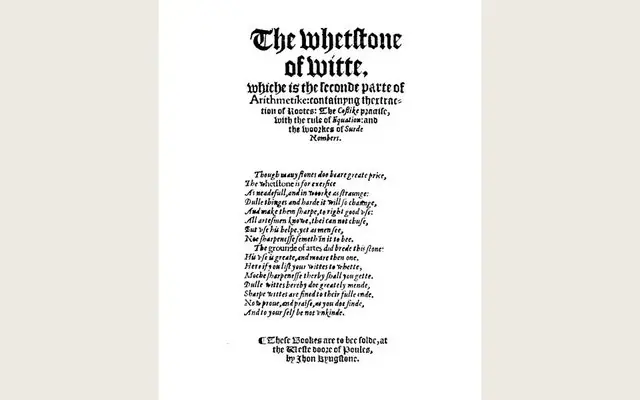
The title page shown with this story comes from the 1557 book; it is not a portrait of Recorde and not the internal page where the equality mark appears. Keeping those functions distinct prevents an attractive cover from becoming misleading evidence. A title page identifies a printed work and places an argument within a material publication. The mathematical passage must be checked inside that work or through a scholarly account of it. Even a very small historical claim benefits from asking exactly what each surviving object can demonstrate.
The equals sign's later success can make its emergence look inevitable. It was not inevitable that readers would settle on these particular strokes or that printers would reproduce them in a standardized form. Recorde's proposal illustrates how economy, an intelligible explanation, and repeated use can work together. The next time two expressions meet across those lines, the mark can be read twice: first as a statement within mathematics, and then as the result of a long process through which writers and readers learned to recognize the same compact instruction.