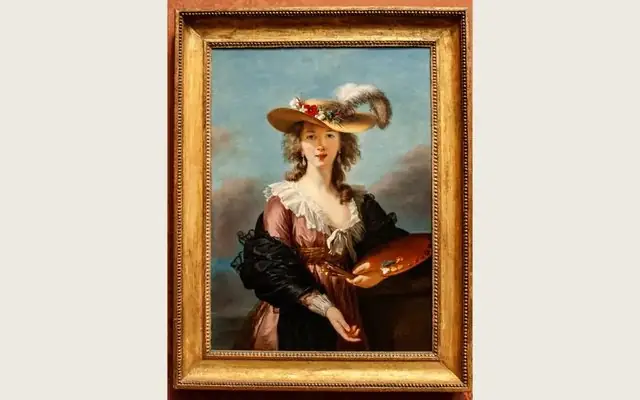
A sitter who is also the painter
A fashionable hat might seem an unlikely place to begin a story about professional authority. Yet in Élisabeth Louise Vigée Le Brun's self-portrait, elegance shares the canvas with the equipment of work. She looks toward the viewer while holding a palette and brushes. The combination makes a straightforward claim without a written declaration: the woman presented for inspection is also the person capable of making the image. The painting invites appreciation of a sitter while making it difficult to forget the skill and agency of its maker.
Born in 1755, Vigée Le Brun became an accomplished portraitist in a profession whose institutions offered women restricted opportunities. The Metropolitan Museum's account of her career emphasizes both her largely self-directed training and her exceptional success. A portrait career depended on much more than handling paint. Patrons had to trust the artist with their public appearance, and pictures circulated judgments about status and character. A self-portrait could enter that same exchange while allowing the painter to decide which version of herself would represent her abilities.
Looking at light and professional identity
The National Gallery's Straw Hat painting develops an idea inspired by a portrait by Peter Paul Rubens. Its interest includes the relationship between daylight and direct sunlight, with the brim creating shadow across the face. This is more than a borrowed fashionable accessory. It presents a problem in painting light, then makes the result look relaxed. The museum identifies its canvas as the artist's signed copy of her 1782 original, probably painted in the same year. Recognizing that distinction avoids treating every reproduction of the composition as a photograph of one unique object.
The working tools are equally deliberate. A palette offers evidence of color being selected and mixed; brushes connect the depicted hand to the construction of the portrait itself. The viewer moves between the illusion of a person standing nearby and the knowledge that a person arranged this illusion. The National Gallery's account also distinguishes details between versions, including the dress and background. Such differences show why a copy made by the artist can remain a considered work. Repetition need not mean an indifferent mechanical duplicate or the disappearance of creative choice.
Recognition and a career across borders
Institutional recognition followed in 1783 when she entered France's Royal Academy. The Met explains that her husband's work as an art dealer had initially posed an obstacle, and that intervention associated with the queen helped secure admission. This episode should not be reduced to either effortless privilege or a career without patronage. Royal connections created opportunities while women still encountered rules that constrained participation. Her success makes the restrictions easier to see because it records both the strength of her reputation and the negotiations required for formal recognition.
Other surviving paintings show the breadth of work behind the celebrated self-image. The National Gallery of Art records her 1787 portrait of the Marquise de Pezay with the Marquise de Rougé and her sons, as well as Madame d'Aguesseau de Fresnes, dated 1789. These are different arrangements of people, relationships, and materials, rather than interchangeable demonstrations of prettiness. Looking across them asks how a painter organized a group or addressed an individual sitter. The dated collection records anchor a public career in particular objects that can still be examined.
Reading the painting without flattening its history
The French Revolution changed the circumstances of that career. Closely associated with the royal world, Vigée Le Brun left France in 1789. The Met's exhibition traces her work through European centers including Rome, Florence, Naples, Vienna, and Saint Petersburg. Exile did not end portrait production, but it changed the networks through which commissions and recognition were obtained. The geographical range should not make departure sound like a carefree tour. A successful traveling artist could retain professional resources while still living with the consequences of political upheaval and separation from home.
The Straw Hat portrait remains compelling because it holds several ideas together without resolving them into a slogan. It is elegant, technically purposeful, and explicit about artistic work. Knowing the career around it deepens the encounter without requiring every brushstroke to predict later events. The image was made before the revolutionary departure, not as a retrospective illustration of it. Its most immediate invitation is still to look carefully: at the face beneath the brim, the tools in the hand, and the professional intelligence that arranged both for an audience.