A landscape with more than one past
A cliff can preserve something that a clock cannot show: the disappearance of an entire landscape before another takes its place. For James Hutton, the Scottish investigator who lived from 1726 to 1797, rocks were evidence of successive worlds rather than a static backdrop. His interest was not simply that the Earth looked old. It was that familiar processes could explain a sequence of changes requiring extraordinary time. The challenge was to reconstruct that sequence from relationships visible in the ground, without possessing a numerical calendar for its beginning.
Hutton brought an unusually varied background to this task. Trained in medicine, he also worked as a farmer before returning to Edinburgh and its intellectual circles. Farming encouraged attention to soil, weathering, and the movement of material across a landscape. Those experiences did not automatically produce a geological theory, but they made ordinary processes worth investigating. The Edinburgh Geological Society traces his work through observations at several Scottish localities. His argument grew from comparisons between places, rather than from the sudden interpretation of a single picturesque rock face.
Reading the order of events
Siccar Point supplied a particularly striking example. In 1788, Hutton visited the coast with John Playfair and Sir James Hall. There, steeply tilted older rocks lie beneath much less steeply inclined sandstone. An unconformity is the contact representing a break in the geological record. Its importance lies in the order of events it requires. Older sediments had to accumulate, become consolidated, and be disturbed before erosion exposed them. Later material then collected across that worn surface. The meeting of the layers compresses a complicated history into one visible relationship.
That interpretation asks a visitor to distinguish observation from inference. The contrasting angles can be seen directly; the vanished episodes are reconstructed from them. Hutton did not watch the older beds tilt or the younger sandstone form. He used their arrangement to reason backward. This makes the site more interesting than a monument to someone being right. It demonstrates a method of investigation: identify a relationship, consider what must have happened first, and compare the proposed sequence with other evidence. A coastline becomes a record even where some of its pages are missing.
A theory built across years
The theory also had a publication history longer than a famous excursion. Hutton presented his ideas in 1785, and a version appeared in the Royal Society of Edinburgh's Transactions in 1788. An expanded book followed in 1795. These dates matter because the work was neither invented nor published all at once at Siccar Point. Field observations, discussion, and writing supported one another. The Royal Society of Edinburgh places Hutton among its founding fellows, linking the geological argument to institutions through which evidence could be shared and challenged.
His account emphasized recurring processes of erosion, sedimentation, and renewal. Land wears down, material accumulates, and geological forces create conditions for further land to emerge. The American Museum of Natural History explains the lasting importance of using processes observable in the present to investigate the past. This approach did not mean that every event happened slowly or at an identical rate. Nor did it provide the modern mechanisms and measurements available to geologists today. It offered an explanatory framework that made a very long history necessary and open to investigation.
What deep time does and does not mean
The word uniformitarianism is often attached to Hutton, but the label came later. Treating that vocabulary as his own would blur the development of geological thought. The same caution applies to the Earth's numerical age: Hutton did not measure it using modern radioactive dating. His achievement concerned the scale and intelligibility of time, not the announcement of today's accepted figure. Later investigators developed, criticized, and extended this way of reading the planet. A history of science becomes clearer when an influential proposal is separated from everything subsequently built upon it.
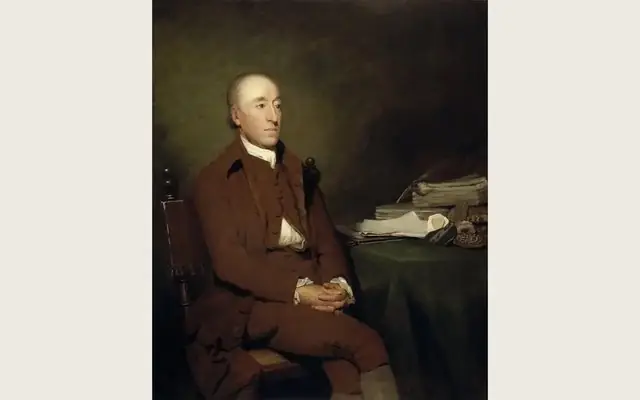
Looking at an unconformity therefore involves two kinds of patience. One is the patience imagined in the processes themselves; the other belongs to interpreting incomplete evidence carefully. Hutton made the apparently familiar ground demand a less familiar sense of duration. The portrait accompanying this story shows the investigator, not the ancient events he reconstructed. Those events remain accessible through rocks and their relationships. His enduring invitation is practical: look beyond the surface appearance of a landscape and ask what sequence of changes had to occur before it could look this way.