A window instead of a specimen hauled aboard
A creature hauled from deep water reaches the surface in conditions very different from those it inhabited. To understand the ocean, an observer might want to see living animals where they actually moved. That ambition helped bring William Beebe and engineer Otis Barton together around an unusual vessel: a metal sphere fitted with windows and lowered from a ship. The Bathysphere did not offer freedom to roam the seabed. It offered something more limited, but historically important: the possibility of a person looking outward from inside the deep ocean itself.
Beebe’s work developed within the New York Zoological Society’s wider research program. The Wildlife Conservation Society, its successor, records the Department of Tropical Research establishing headquarters and laboratories on Bermuda’s Nonsuch Island in 1928. Its work extended across marine environments, not simply to one spectacular descent. This context helps separate a scientific program from a record attempt. The purpose of going deeper was connected to questions about living organisms and their surroundings. A depth number could attract attention, but the observations made during the journey were the reason for undertaking it.
The sphere and the people on the surface
Barton proposed a spherical design suited to resisting external pressure, with thick transparent windows allowing observation. The American Physical Society’s historical account distinguishes his engineering contribution from Beebe’s role in organizing research and obtaining support. That division is worth retaining because the famous image of two men inside one vessel can conceal different kinds of expertise. A question about ocean life required an answer to a structural problem before it could become an observation. Cooperation linked the scientific aim to the physical conditions that would otherwise make the journey impossible.
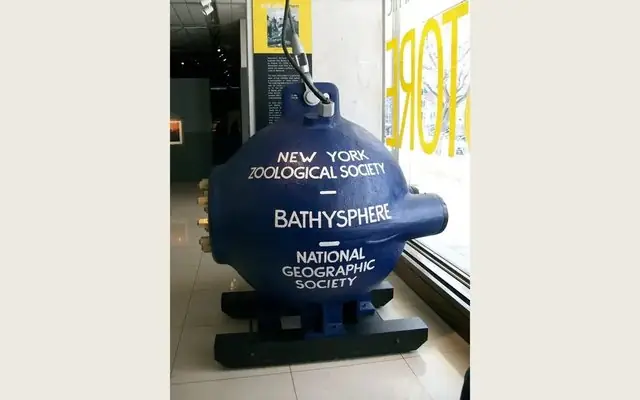
The apparatus was part of a larger system at the surface. A suspension cable lowered and raised it, while separate connections provided electrical and telephone communication. It had no independent propulsion that would let its occupants choose a route through the water. The modern museum photograph reproduced here shows the vessel on display in 2009, rather than during the expedition. Its compact form conveys the restricted space, but the absent ship and lifting equipment were just as essential. A photograph of the sphere alone is therefore an incomplete picture of how the dives worked.
A record built from a sequence of tests
Early tests preceded the best-known record. The American Physical Society describes unmanned trials in 1930, problems involving twisted cables, and later journeys carrying the two men. The progression makes an important point about exploration: reaching a depth was not simply a matter of paying out more cable. Connections had to function, water had to remain outside, and recovery had to be possible. Each successful descent depended on work done before and above it. The history is more informative when the tests remain visible alongside the celebrated achievement that followed them.
On 15 August 1934, Beebe and Barton reached 3,028 feet below the surface near Bermuda. Smithsonian Ocean and the Wildlife Conservation Society both record the depth, with Smithsonian giving its metric equivalent as 923 meters. The achievement remained a record until Barton went deeper in a different vessel in 1949. These dates place the Bathysphere within a continuing history of submersibles, rather than making it the final solution to deep-sea access. Its tether imposed restrictions, even as its windows allowed observations that collecting nets alone could not supply.
Observing a world without possessing a specimen
Direct observation brought its own problems of evidence. An observer could describe motion, color, or an encounter without bringing an animal back for other researchers to inspect. Communication and documentation helped observations travel beyond the sphere, but description was not the same thing as a preserved specimen. This is a useful distinction when reading vivid accounts of unfamiliar deep-sea creatures. The scientific value of seeing animals in place does not make every interpretation unquestionable. A historically careful account can recognize the new access while retaining the difference between an experience, its record, and a subsequently testable identification.
The Bathysphere changed the position from which a human could ask questions about the ocean. It also exposed how dependent that apparently isolated observer remained on others. Engineering, ship handling, cables, communications, funding, and documentation surrounded the person at the window. Remembering that network gives the famous descent a fuller meaning than a contest over depth alone. The surviving vessel can look like a sealed world of its own, yet its achievement depended on connections. Those connections made it possible to turn an extraordinary journey into observations that people on the surface could discuss.