Flowers made for a working loom
At first glance, a floral silk can seem to preserve a garden. Its stems bend, its leaves turn, and its flowers create an impression of movement across a pale ground. But the textile also preserves a chain of decisions made by people working with paper, thread, and a loom. Anna Maria Garthwaite’s surviving designs make that chain unusually visible. Her flowers were not simply pictures to admire. They had to become instructions another craft worker could use, while satisfying customers whose expectations changed with the fashion for dress.
Garthwaite established a successful career in eighteenth-century Spitalfields, the London district closely associated with silk weaving. English Heritage places her working home at what is now 2 Princelet Street. The house connected a designer to a neighborhood of weavers and traders, rather than isolating her as an artist producing finished objects alone. The local industry owed much to Huguenot refugees and their expertise. This setting helps explain how a drawing could find a commercial destination: skilled making depended on relationships between occupations as well as on the quality of an individual design.
A career reconstructed from designs
The route by which she learned remains uncertain. The Metropolitan Museum of Art explicitly says that it is not known how she acquired the art of designing for silk weaving. The London Museum likewise finds no evidence of formal training in the trade. An absence of documentation is not evidence that the work required little knowledge. The ability to translate a composition into something usable at a loom demanded practical understanding. Her achievement is clearer when that uncertainty is preserved, instead of filling the gap with an invented apprenticeship or a dramatic moment of inspiration.
Much of her working life can be approached through the drawings themselves. Dates and annotations sometimes name the weavers who bought a pattern; English Heritage notes the care with which she recorded designs and customers. These are small marks with large consequences for interpretation. They connect an attractive composition to a transaction and a period of production. The London Museum observes that her surviving watercolours offer fragments of a voice that is not otherwise preserved in a personal diary. Looking at a margin can therefore be as informative as examining a flower.
The distance between paper and woven cloth
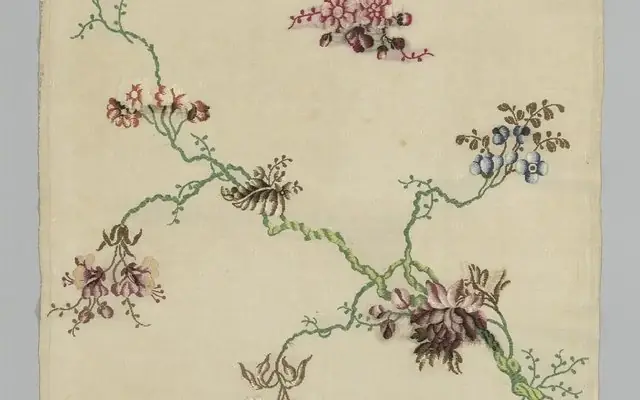
A length of silk in the Metropolitan Museum, woven by Thomas Brant in 1748, offers a particularly useful comparison. The museum identifies a related original design in the Victoria and Albert Museum and notes differences between the drawing and the finished textile. The weaver adjusted the colors and introduced texture into the background. The cloth was consequently not a mechanically exact transfer of a solitary designer’s intention. It resulted from interpretation within a skilled production process. The surviving relationship allows us to recognize Garthwaite’s work without making the weaver disappear from the story.
The reproduced textile shows how much a pattern relies on the space around its motifs. The museum describes floral sprays on a white ground and a branch that moves across the width. The plants invite attention, but the intervals make the composition legible across a length of fabric. A design for clothing also has to survive repetition and use. A museum photograph presents a surface for inspection; a historical wearer encountered cloth folded, cut, and in motion. Those are different ways of seeing the same material, and neither should be mistaken for the whole object’s life.
Following a designer through surviving objects
Garthwaite’s work circulated beyond London. English Heritage and the London Museum connect her designs with surviving textiles, costume collections, and portraits in Europe and North America. This does not mean every similar floral garment can safely be attributed to her. Museum descriptions sometimes retain a question mark or identify a piece as being in her style. Such caution is valuable: resemblance can establish a wider visual fashion without proving a particular commission. Securely connected drawings and textiles give a firmer basis for studying her practice than an unrestricted catalogue of everything that looks similar.
The drawings make an exceptional career visible through ordinary business evidence. Their dates, names, and technical observations show a designer responding to a market while working within the possibilities of a material. The silk reproduced here is a surviving result, not a complete record of every hand involved. Reading it alongside the paper designs brings those missing relationships back into view. A flower on a woven surface can then tell two stories at once: one about fashionable appearance, and another about the precise coordination required to turn an image into cloth.