An instrument for the eyes as well as the ears
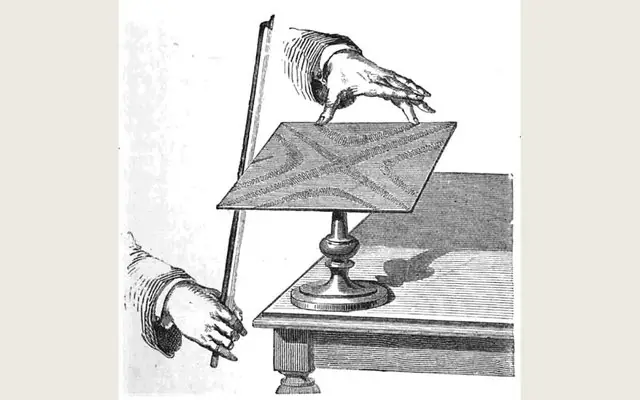
A metal plate, a violin bow, and a little sand make an unlikely drawing kit. Yet together they can produce a pattern without anyone tracing its lines. As the plate rings, its grains move away from strongly vibrating areas and gather in quieter places. The resulting figure makes an otherwise difficult motion visible. Associated with the German experimentalist Ernst Chladni, these acoustic figures connected musical experience with physical investigation. Their attraction lies in a useful reversal: the sand draws attention to the parts of the sounding object that hardly move.
Chladni published his investigations in 1787. The collection of scientific instruments shared by the University of Lausanne and EPFL identifies that year with the publication of the geometric figures. This was a method for studying how solid surfaces vibrate, rather than a way of photographing sound traveling through the air. The distinction matters because the visible lines belong to the behavior of a particular plate. Its outline, thickness, support, and manner of excitation influence the result. One ringing object can therefore yield several figures instead of possessing a single permanent acoustic signature.
Why the grains gather into lines
The sand is an indicator, not the agent that creates the sound. Harvard’s demonstration collection explains the contrast between nodes, where motion is minimal, and antinodes, where it is greater. Grains are displaced from the latter and accumulate near the former. A pattern becomes clear when an appropriate mode of vibration is excited. The visual result can look like a decorative emblem, but the regularity has a physical cause. What appears to be a network drawn across the surface is evidence of a surface moving in organized regions.
A demonstrator can influence the figure without changing the plate itself. Harvard describes bowing the edge while touching another point with a finger, which constrains motion there. Changing those positions can favor a different mode. This is why the hand shown beside a bow in an old illustration deserves attention: it is part of the experimental arrangement. The picture reproduced with this story comes from an 1879 sound textbook. It is a later teaching image, not a record of Chladni making his original discovery, and its date is part of its meaning.
A demonstration travels through instruments and books
Instruments preserved by museums show how the experiment traveled beyond an individual investigator. A Smithsonian example consists of square and circular brass plates of different thicknesses on a stand. The institution associates its acquisition in the 1860s with the Paris instrument maker Rudolph Koenig. Such an apparatus allowed comparisons to be arranged in front of a class or audience. The assortment also turns a simple question into a sequence: what changes when the outline changes, and what changes when thickness does? A collection of plates makes differences available for deliberate examination.
Books extended that demonstration to readers who could not attend it. John Tyndall’s Sound discusses Chladni’s figures within an account of vibrating rods, forks, plates, and other sounding bodies. The printed explanation connected an arresting experiment to broader questions about vibration. A diagram could preserve a configuration after its ringing had stopped, but it could not replace all the actions that produced it. Reading the diagram alongside the description restores the importance of handling, support, and observation. The picture is a record of a method as well as a striking result.
What a beautiful pattern can actually tell us
Later teaching collections retained both bowed plates and devices driven by an adjustable source. The Lausanne and EPFL catalogue describes the transition from a bow to a loudspeaker-based arrangement, while still explaining the same accumulation of sand at relatively stationary regions. Keeping these versions together prevents an easy mistake: an old experiment can remain useful even when its apparatus changes. The essential comparison survives, while newer equipment makes particular conditions easier to control. Continuity belongs to the question and the observable relationship, rather than to an untouched set of tools.
Chladni’s figures are memorable because they reward looking closely at something usually approached by listening. Their beauty is also a reminder to ask what an image represents. The lines do not reveal every property of sound, and a plate is not the same thing as a stretched drum membrane. Nevertheless, the experiment makes a specific physical relationship accessible through ordinary materials. A little sand converts rapid motion into a lasting arrangement that people can compare, describe, and question. That combination helped a theatrical demonstration become an enduring instrument of scientific understanding.