The living animal behind the collected case
A delicate argonaut case could reach a collector without revealing how the animal inside had obtained it. Jeanne Villepreux-Power approached that uncertainty by keeping marine animals alive and watching what they did. In the waters around Messina, Sicily, she developed tanks and cages that made repeated observation possible. Her work helped establish that the argonaut produced its own case rather than occupying a shell made by another creature. The result depended on changing the conditions of study: a living animal could answer questions that an isolated, dried object could not.
Villepreux-Power was born in France in 1794 and worked as an embroiderer before settling in Sicily after marriage. Oxford’s Museum of Natural History describes her broad interests in the island’s geology, archaeology, and natural history. She built collections and obtained marine specimens with help from local fishermen. That setting matters because the research began with access to particular animals and a coastline. Her later reputation as an inventor can obscure those practical relationships. Collecting, maintaining, and returning to living specimens formed the everyday basis of the investigation.
Tanks and sea cages as research equipment
Her aquaria were a family of devices rather than one universal glass box. The University of Porto research project She Thought It describes indoor glass containers, protected glass vessels submerged in the sea, and larger wooden cages for use in marine water. Different arrangements served different animals and working conditions. Water had to circulate while the organism remained available for inspection. The point was not merely to exhibit an attractive miniature sea. The apparatus changed what a naturalist could observe over time, making the animal’s behavior part of a continuing experiment.
Calling her the inventor of the aquarium is common, but a more precise account emphasizes her pioneering systematic use of these devices for marine research. A historical study by Josquin Debaz discusses the cages without claiming to settle every question of priority. It describes their installation near Messina’s lazaretto, damage from a storm, and the effort required to keep the work going. Equipment placed in the sea remained vulnerable to the sea. The survival of an experiment depended on repairs, feeding, and repeated attention, not simply on drawing a clever design.
Repair experiments and evidence sent to London
The central dispute concerned whether Argonauta argo secreted the structure commonly called its shell or borrowed it like a hermit crab. The female argonaut’s delicate case is associated with its eggs, a distinction that prevents confusion with the chambered shell of a true nautilus. Villepreux-Power examined living animals and their capacity to repair damage. Debaz’s account describes experiments in which damaged cases were followed through successive stages of repair. Observations over time supplied evidence of production and renewal that a collection of empty cases alone could not establish.
Convincing distant naturalists required another kind of arrangement. Specimens showing growth and repair were preserved so that Richard Owen could present evidence to the Zoological Society of London in 1839. The collection carried stages of an investigation away from Sicily. In this respect, preservation was not merely the storage of finished results; it helped communicate how the conclusion had been reached. Critics could compare bodies, cases, and repaired areas. The argument moved through correspondence, publications, and material specimens, linking a seaside working environment to a metropolitan scientific meeting.
Publications, surviving records, and the value of observation
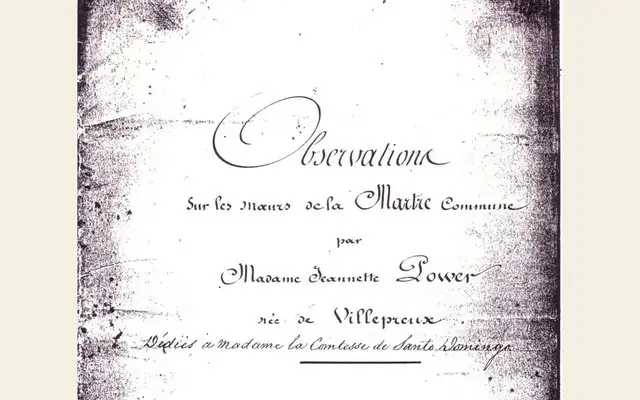
Her publications also ranged beyond the argonaut. The historical accounts identify an itinerary of Sicily in 1839 and a fuller guide in 1842, alongside later descriptions of experiments. Losses in a shipwreck destroyed much of her collected material, although accounts differ over the date and it should not be presented here as securely settled. The loss did not erase every record of her work. Printed texts, correspondence, and surviving visual material provide other routes into the investigation. The image accompanying this article shows a document associated with her work, not a confidently identified portrait of the naturalist.
Villepreux-Power’s story therefore makes the aquarium more interesting than a familiar household object with an inventor’s name attached. Its research value came from the relationship between enclosure and observation. Keeping an animal within reach made it possible to return to the same question, alter a condition, and compare an outcome. Communicating that process then required specimens and descriptions that others could examine. Her lasting contribution was both practical and intellectual: she helped make living marine behavior available as evidence, while showing why a convincing explanation sometimes requires patience with an animal rather than confidence in an inherited analogy.