A movement too fast for a single glance
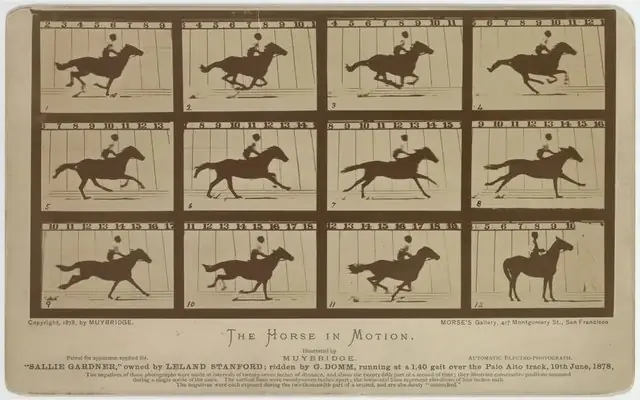
Watching a horse gallop gives an impression of continuous movement. A sequence of photographs asks a different question: what positions does the animal pass through between the moments the eye can separate? Eadweard Muybridge’s horse studies made those positions inspectable. The images are now often encountered as a short animation, but their original arrangement on cards invited comparison between still frames. Their historical importance lies in that change of attention. Movement could become a set of records that a viewer could revisit, number, and discuss instead of relying entirely on a fleeting visual impression.
Leland Stanford asked Muybridge to investigate a running horse in 1872. Stanford’s interest concerned whether all four feet left the ground during the stride. According to the University of Pennsylvania’s archival account, the early results were inconclusive and the successful series followed years of improvement. Faster exposures and more reliable triggering mattered as much as the initial question. This chronology resists the familiar compression of invention into a single brilliant afternoon. The published photographs of 1878 were the outcome of an evolving apparatus designed to record events too brief for an ordinary exposure.
Successive exposures and the information around them
Muybridge used multiple cameras to divide the movement into successive views. The Metropolitan Museum describes timed releases and wires across the animal’s path among the triggering methods used in his work. Its discussion of a twenty-four-camera arrangement should not be treated as a fixed count for every session. Different studies employed different configurations. What they shared was the separation of one moving body into multiple photographic records. The resulting poses sometimes appeared awkward because they contradicted expectations built from observation and pictures, rather than because the animal had suddenly begun to move unnaturally.
The National Gallery of Art preserves an 1878 Horse in Motion print with twelve views arranged in three rows. Its inscription identifies the mare Sallie Gardner, Leland Stanford’s ownership, and the Palo Alto track on June 19, 1878. It also describes spacing and timing. These printed details are part of the evidence, not decorative margins to be ignored. They tell a reader what sequence is being claimed and how its separate positions relate. A reproduced frame without its surrounding information would make a striking silhouette, but would convey much less about the experiment.
From horse cards to Animal Locomotion
A Library of Congress group record places the work within a larger set of horse studies. It describes horses walking, trotting, cantering, and running, printed on cards by Morse’s gallery in San Francisco. Different gaits were therefore objects of comparison rather than interchangeable examples of speed. A trot and a gallop organize an animal’s limbs differently. Keeping the labels and sequences together allowed viewers to examine such distinctions. The camera’s contribution was not merely to stop motion; the arrangement of the resulting photographs made a particular kind of comparative reading possible.
The investigation later expanded in Philadelphia. University backing and support from local cultural and financial figures enabled Muybridge to pursue Animal Locomotion on the Penn campus. The university’s biography dates its publication to 1887 and records 781 plates. Improvements to timing and shutter release accompanied that expansion. The scale of the publication should not be confused with the number of photographs on one card or the number of cameras in an earlier installation. Those quantities describe different parts of a changing project, whose production depended on institutional resources as well as photographic ingenuity.
Still evidence and an impression of movement
These images also occupy an unusual position between analysis and spectacle. Displaying frames together lets the viewer compare differences; presenting a sequence through an optical device can produce an impression of movement again. The two uses are related but do not amount to identical evidence. A modern animated file assembled from the photographs is not an untouched film shot in 1878. The still card reproduced here retains its original comparative format. It allows a viewer to pause at each position and to recognize how much meaning is supplied by order, spacing, and the accompanying text.
Muybridge’s achievement consequently belongs to a history of methods as much as to a history of memorable pictures. A question about a horse became answerable through a sequence whose components could be inspected separately. The grid made a rapid action legible, while the captions connected it to a particular animal and place. Understanding those elements avoids treating the work as simply the first version of a modern camera clip. Its distinctive power was to interrupt continuity deliberately, so that what had passed too quickly to examine could become a record available for sustained comparison.